AI estimate as of August 11, 2025 · verify with a professional before acting
AI-Generated · Verify before acting
Everything on this page is generated by AI for informational purposes only. AI can make mistakes — the AI may misidentify items or misattribute them (artist, maker, brand, designer, origin, era). This is not an official valuation and should not be used for insurance, sale, tax, estate, legal, or lending purposes — or any decision requiring a certified appraisal. It is not an authoritative claim about any person, brand, or rights holder — do not share or rely on it as a factual statement about a third party. Always consult qualified professionals before making financial decisions.
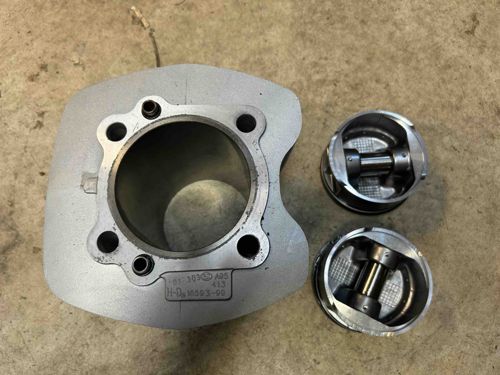
The item displayed consists of one engine cylinder head and two pistons, likely for a motorcycle, specifically a Harley-Davidson. The cylinder head is made of a light-colored, possibly aluminum alloy, given its matte silver-gray finish, and appears to be sand-cast or die-cast. It has a large central bore for the piston, surrounded by six bolt holes for mounting to an engine block. The surface shows some minor scuffs and marks consistent with handling and removal from an engine, but no significant damage like cracks or deep gouges are immediately apparent. There's a visible manufacturing stamp on the bottom flange, which includes the numbers "161303 ACS 413" and "H-D 16503-00", clearly indicating its Harley-Davidson origin and a part number suggesting a manufacturing year around 2000. The inside of the cylinder appears unmarred, exhibiting a smooth, honed surface, indicating that it may be in good, reusable condition or recently reconditioned. The two pistons are also made of metal, likely aluminum alloy, displaying a bright, shiny, machined finish on their crowns and sides. Each piston features grooves for piston rings (which are not present in the image) and a central bore for a wrist pin (which is installed in both pistons). The undersides of the pistons show a ribbed or latticed structure for strength and weight reduction. They appear to be standard, possibly OEM, components. Visible condition includes some carbon residue or discoloration on the domes of the pistons, suggesting prior use within an engine, but no major scuffing or damage to the skirts or ring lands is discernible from this view. The overall quality appears to be consistent with durable, precision-engineered engine components.
AI Appraisal Report
Upon examining the provided image of the Harley-Davidson engine cylinder head and two pistons, my assessment is that these components are in good, reusable condition. The cylinder head, identified by part number H-D 16503-00, suggests a manufacturing date around 2000, consistent with its appearance. The visual lack of significant damage such as cracks or deep gouges, and the smooth, honed interior surface of the cylinder, indicate good structural integrity. The pistons show signs of prior use, specifically carbon residue, but no apparent major scuffing or damage to the skirts or ring lands.
Authenticity is strongly supported by the visible 'H-D' stamping and the recognizable part number. These components appear to be genuine Harley-Davidson parts.
Market conditions for used OEM Harley-Davidson engine components can vary. While new parts are readily available, there's a consistent demand for used, good-condition parts for repairs, restorations, or custom builds, especially for older models where new parts might be scarcer or more expensive. This specific cylinder head and piston set, likely for a Twin Cam engine, falls into a category with reasonable demand. They are not exceedingly rare, but finding a matched, good-condition set can add value.
Factors impacting value include the excellent apparent internal cylinder condition, the visual lack of damage, and the clear Harley-Davidson identification. The fact that the pistons are included, and appear to be a good match for the cylinder, also adds value.
Limitations in authenticity verification from an image alone are present. While the stamps strongly suggest authenticity, a physical inspection would confirm casting quality, part weight, and internal dimensions. I would typically perform Rockwell hardness testing on the cylinder head and bore measurements to confirm it's within specification or hasn't been over-bored. Full provenance documentation, such as service records, could further enhance confidence in their history and authenticity, but this is less common for individual components.