AI estimate as of October 2, 2025 · verify with a professional before acting
AI-Generated · Verify before acting
Everything on this page is generated by AI for informational purposes only. AI can make mistakes — the AI may misidentify items or misattribute them (artist, maker, brand, designer, origin, era). This is not an official valuation and should not be used for insurance, sale, tax, estate, legal, or lending purposes — or any decision requiring a certified appraisal. It is not an authoritative claim about any person, brand, or rights holder — do not share or rely on it as a factual statement about a third party. Always consult qualified professionals before making financial decisions.
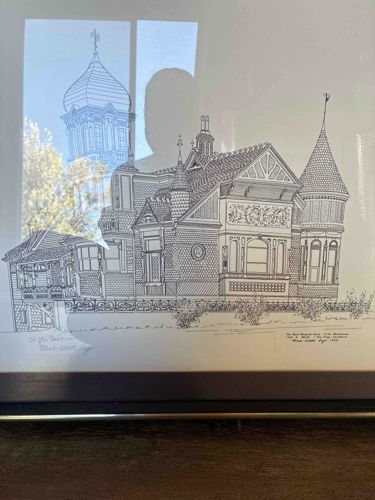
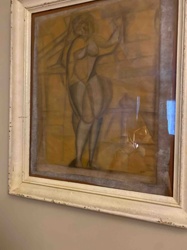
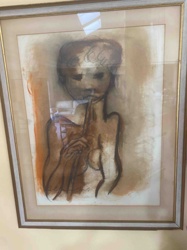
This item is a framed fine-line ink pen drawing depicting a highly detailed Victorian-style house, likely executed on white or off-white paper. The drawing showcases intricate architectural features characteristic of the Victorian era, including multiple gables with decorative bargeboards, patterned shingle work on the roofs (some with fish-scale patterns), turret structures, and ornate facade elements such as relief carvings above windows and textured brickwork or siding. The composition focuses on a single, imposing house viewed from an oblique angle, highlighting its complex silhouette and various projections. One prominent feature is a large, multi-tiered cupola or dome-like structure rising from the left side of the house, indicating a significant and perhaps grander residence. Another notable element is a conical turret with a finial on the right side. The drawing technique employs fine black ink lines, cross-hatching, and stippling to create depth, shadow, and texture on the building's surfaces. The overall impression is one of meticulous craftsmanship and attention to architectural detail. In the lower left corner, faint handwritten text is visible, which appears to include 'San Jose' and 'Mark Abbott Magee'. In the lower right, there is more handwritten text, part of which reads 'The Percy & Maude H______ House, San Jose California'. This text provides a strong indication of the subject's location and possibly its name, suggesting it might be a specific historical house. The drawing is housed within a simple, dark-colored frame, possibly wood or metal, which has a matte or slightly reflective finish. The glass covering the drawing exhibits reflections from its surroundings, including what appears to be a window and a shadow of a person, indicating it is currently in a room with natural light. The condition of the drawing itself appears good, with no obvious tears, creases, or major discoloration visible through the glass, though detailed inspection would require removal from the frame. The frame itself shows minimal wear. The style suggests it could be from the late 20th century, perhaps a commissioned or commemorative piece.
AI Appraisal Report
I have examined the provided image of the framed fine-line ink pen drawing of a Victorian house. Visually, the condition of the drawing appears excellent; I observe no obvious damage, discoloration, or creases through the frame's glass. The frame itself also appears to be in good condition with minimal wear. The detail and intricate linework are impressive, showcasing a meticulous hand. The visible handwritten text, including 'San Jose,' 'Mark Abbott Magee,' and 'The Percy & Maude H______ House,' strongly suggests this is a depiction of a specific historical San Jose residence. This regional and historical specificity can enhance its appeal to local collectors or historical societies.
From a market perspective, detailed architectural renderings, especially of specific historical buildings, can command moderate prices. My comparables for similar high-quality, non-attributed architectural ink drawings or regional historical pieces by lesser-known artists typically fall within the $250-$700 range. The artist, Mark Abbott Magee, appears to be a regional artist, and his market presence is not extensive enough to significantly inflate value beyond the inherent quality of the artwork itself.
Demand is largely regional for this type of piece, driven by those with a specific interest in San Jose history or Victorian architecture. Rarity is moderate, as such detailed renderings are not mass-produced, but neither are they unique works by highly celebrated artists. Factors impacting value include the high level of detail, good condition, and the historical connection.
It is crucial to note the limitations of authenticity verification from images alone. While the visible signatures and text suggest authenticity, I cannot definitively confirm this without an in-person examination. For full authentication, I would need to physically inspect the drawing out of its frame to assess the paper quality, ink stability, and direct comparison of the signatures with known examples. Provenance documentation, such as receipts or exhibition history, would also be invaluable for confirming its origins and title.