AI estimate as of October 4, 2025 · verify with a professional before acting
AI-Generated · Verify before acting
Everything on this page is generated by AI for informational purposes only. AI can make mistakes — the AI may misidentify items or misattribute them (artist, maker, brand, designer, origin, era). This is not an official valuation and should not be used for insurance, sale, tax, estate, legal, or lending purposes — or any decision requiring a certified appraisal. It is not an authoritative claim about any person, brand, or rights holder — do not share or rely on it as a factual statement about a third party. Always consult qualified professionals before making financial decisions.
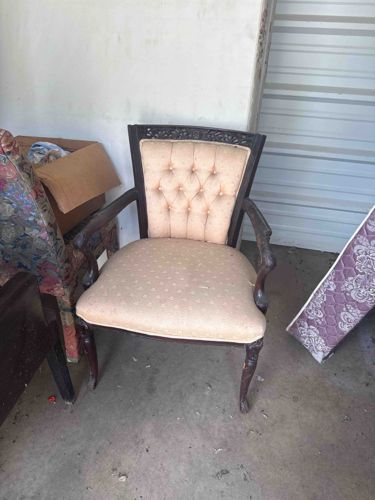
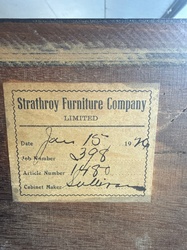
This is a vintage armchair featuring a dark-stained carved wooden frame and light-colored upholstered cushions. The chair exhibits a classic design with ornamental detailing, particularly visible along the top rail of the backrest, which appears to have a relief carving, possibly floral or scrolled motifs. The back cushion is tufted, creating a diamond-patterned dimpling effect, and is upholstered in a light, possibly cream or pale peach, fabric. The seat cushion is also upholstered in a matching or complementary light-colored fabric, which appears to have a subtle dotted or textured pattern. The armrests are carved, showing some organic, possibly foliate, details, and transition into slightly cabriole-style front legs that appear to be carved as well, though specific details are hard to ascertain from the image. The wood frame exhibits a dark finish, likely mahogany or walnut, and shows signs of wear consistent with age and use, including scratches, scuffs, and possibly some loss of finish, contributing to a visible patina. There are no visible manufacturer's marks or signatures, but the style suggests a mid-20th-century or earlier period, possibly in the Queen Anne, Chippendale, or a similar traditional style adapted in the early to mid-1900s. The upholstery shows some signs of use, including slight discoloration or dust accumulation, but no overt tears or significant damage are immediately visible. The overall construction appears sturdy, indicating quality craftsmanship for its time.
AI Appraisal Report
Upon visual examination of the provided image, I assess this vintage carved wood armchair with tufted upholstery. The chair presents in good vintage condition, exhibiting character consistent with its age. I observe a dark-stained carved wooden frame with ornamental detailing, particularly along the top rail and armrests, suggesting a traditional aesthetic, possibly Queen Anne or Chippendale influenced, adapted for the early to mid-20th century. The tufted back cushion and upholstered seat are in a light-colored fabric, which appears relatively clean, showing minor signs of use like slight discoloration or dust, but no obvious tears or significant damage. The dark wood finish shows expected wear such as scratches, scuffs, and possibly some finish loss, contributing to a desirable patina rather than detracting significantly from its appeal.
Market conditions for vintage traditional furniture, while stable, are not experiencing a boom. Demand is present for well-maintained, aesthetically pleasing pieces. Comparables typically include similar carved armchairs from the early to mid-20th century, often found in antique shops or online marketplaces. Rarity is not a significant factor here; while unique in its specific carvings, similar styles were produced in quantity. Factors impacting value include the solid construction, detailed carving, and generally good condition of the upholstery. However, the lack of a known manufacturer or specific historical significance limits its premium potential. Without in-person examination, I cannot definitively determine the wood species beyond likely mahogany or walnut, nor can I verify hidden structural integrity. Authenticity of period style is based on visual cues; provenance documentation would be needed for absolute certainty of its exact age and origin.