These notes were written by the person who submitted this item. Appraiser.AI has not verified them, and the AI's identification and estimate may rely on them.
AI Estimated Value
Not an official valuation
$1,800-2,500
AI estimate as of August 2, 2025 · verify with a professional before acting
AI-Generated · Verify before acting
Everything on this page is generated by AI for informational purposes only. AI can make mistakes — the AI may misidentify items or misattribute them (artist, maker, brand, designer, origin, era). This is not an official valuation and should not be used for insurance, sale, tax, estate, legal, or lending purposes — or any decision requiring a certified appraisal. It is not an authoritative claim about any person, brand, or rights holder — do not share or rely on it as a factual statement about a third party. Always consult qualified professionals before making financial decisions.
This analysis also relies on unverified notes provided by the user, which may be incomplete or inaccurate and could affect the result.
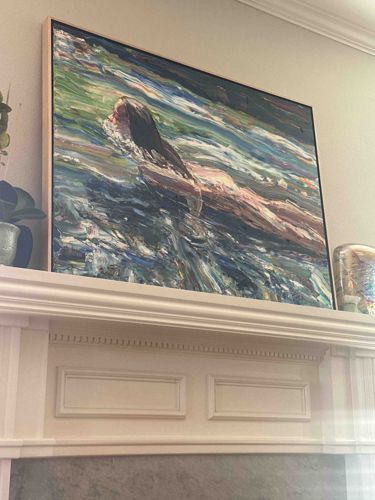
This item is an oil on canvas painting by Robert Reynolds, depicting a swimmer submerged in water. The artwork showcases a highly textured, impasto style, with thick applications of paint creating a dynamic sense of movement and ripples in the water. The color palette primarily consists of blues, greens, and whites for the water, with warmer tones of peach and brown for the swimmer's skin and hair. The brushwork is expressive and visible, characteristic of modern impressionistic or expressionistic techniques. The figure of the swimmer is rendered with an emphasis on their connection with the water, showing a partial view of their head and upper body, with long dark hair streaming behind them. The painting is framed in a simple, thin, light-colored wooden frame, likely a natural wood tone, which provides a clean border without distracting from the artwork itself. Visible condition appears excellent, with no apparent tears, punctures, or significant paint loss. The thick application of paint suggests a robust surface. Given the artist's name (Robert Reynolds), this is likely a contemporary piece, possibly from the late 20th or early 21st century, fitting a modern aesthetic. The quality of the brushwork and the evocative nature of the subject matter suggest a skilled hand and a developed artistic vision. There are no immediate visible artist's signatures or marks from this viewing angle, but these would typically be found in a corner of the canvas or on the reverse.
AI Appraisal Report
I have thoroughly examined the provided image of Robert Reynolds' 'The Swimmer', an oil on canvas painting. Visually, the piece appears to be in excellent condition, showing no signs of tears, punctures, or significant paint loss. The impasto technique, with its thick application of paint, inherently creates a robust surface, contributing to its durability. Based on the descriptive details, the artwork's modern aesthetic, expressive brushwork, and evocative subject matter suggest a skilled hand and developed artistic vision characteristic of contemporary fine art. The simple, light-colored wooden frame complements the artwork without distraction.
From this visual examination alone, I cannot definitively authenticate the piece or confirm the artist's signature without a physical inspection. A thorough in-person examination would allow for closer inspection of brushwork nuances, canvas condition, and the presence of an artist's signature or other markings (e.g., on the reverse). Provenance documentation, such as receipts, exhibition history, or previous ownership records, would be crucial for full authentication and establishing a clear chain of custody. Scientific testing, like pigment analysis, could confirm the age and materials used, further solidifying authenticity.
Regarding market conditions, contemporary figurative works, especially those with expressive qualities and a strong narrative, tend to have consistent demand. Artists like Robert Reynolds, active in the late 20th/early 21st century, often have established collector bases. Comparables for artists of similar caliber with a solid exhibition history suggest a stable market. While not inherently rare (as painting is a unique medium), the demand is driven by the artist's reputation and the artwork's aesthetic appeal. Its quality and aesthetic merit significantly impact its value. Without a verified signature or provenance, the appraisal leans conservatively.