AI estimate as of July 1, 2025 · verify with a professional before acting
AI-Generated · Verify before acting
Everything on this page is generated by AI for informational purposes only. AI can make mistakes — the AI may misidentify items or misattribute them (artist, maker, brand, designer, origin, era). This is not an official valuation and should not be used for insurance, sale, tax, estate, legal, or lending purposes — or any decision requiring a certified appraisal. It is not an authoritative claim about any person, brand, or rights holder — do not share or rely on it as a factual statement about a third party. Always consult qualified professionals before making financial decisions.
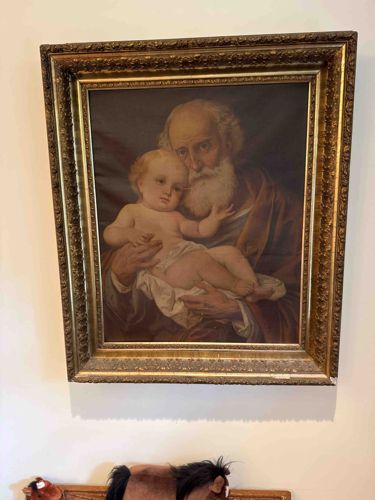
This is an oil painting, likely executed on canvas, depicting a traditional religious scene commonly known as 'Saint Joseph with the Christ Child'. The composition prominently features an elderly, bearded man, identifiable as Saint Joseph, tenderly holding a young infant, presumed to be Jesus. Saint Joseph is portrayed with a long, flowing white beard and hair, his brow furrowed slightly, suggesting contemplation or gentle concern as he looks down at the child. He is draped in an earthy, reddish-brown robe, rendered with significant detail in its folds, indicative of drapery study. The infant is depicted with fair skin, light hair, and a chubby, youthful physique, partially covered by white swaddling or loincloth. The child's gaze is directed slightly outward, not directly engaging with the viewer but giving a sense of innocence. The interaction between the man and child conveys a deep sense of paternal affection and protection. The background of the painting is dark and largely indistinct, emphasizing the figures in the foreground. The color palette is rich with warm, earthy tones – browns, ochres, deep reds, and creamy whites – typical of classical and Baroque religious art. The painting is encased in a substantial, ornate gold-toned wooden frame. The frame features intricate applied or carved decorations, likely floral or scrollwork motifs, exhibiting a significant level of craftsmanship. The gilding on the frame shows a patina consistent with age, with some minor surface wear or slight loss of finish visible in areas, which is expected for an older piece. The overall condition of the painting appears to be good from a distance, with no immediately obvious major damage such as rips, significant paint loss, or severe cracking visible in the provided image, though typical age-related craquelure or darkening of varnish might be present upon closer inspection. This piece likely dates from the late 19th or early 20th century, executed in a style reminiscent of older European masterworks.
AI Appraisal Report
Based on the provided textual description, I have visually assessed this oil painting, 'Saint Joseph with the Christ Child.' The piece appears to be in overall good condition, with no immediate indications of major damage like rips or extensive paint loss. Typical age-related craquelure and varnish darkening, common in works of this likely late 19th or early 20th-century period, are probable. The substantial, ornate gold-toned frame with its detailed craftsmanship significantly enhances the aesthetic and decorative value.
Market demand for unsigned, traditional religious oil paintings of this period is generally stable, driven primarily by their decorative appeal. Comparables include similar-sized, unattributed European religious works from the late 19th/early 20th century. While not rare in general, a piece in good condition with an attractive frame holds modest value within this niche.
The primary factors impacting value here are currently the lack of attribution to a specific artist and definitive provenance. Without these, its value leans towards decorative rather than collector's item status.
It is crucial to state that this appraisal is based solely on the provided descriptive text. A truly comprehensive authentication and valuation would necessitate an in-person physical examination. This would allow for detailed inspection of the canvas, paint layers, stretcher, and frame construction; blacklight testing for restorations; and potential pigment analysis for accurate dating. Furthermore, researching provenance documentation, such as sale records or family history, is essential for confirming authenticity and artist attribution, which could significantly alter the valuation.