AI estimate as of October 5, 2025 · verify with a professional before acting
AI-Generated · Verify before acting
Everything on this page is generated by AI for informational purposes only. AI can make mistakes — the AI may misidentify items or misattribute them (artist, maker, brand, designer, origin, era). This is not an official valuation and should not be used for insurance, sale, tax, estate, legal, or lending purposes — or any decision requiring a certified appraisal. It is not an authoritative claim about any person, brand, or rights holder — do not share or rely on it as a factual statement about a third party. Always consult qualified professionals before making financial decisions.
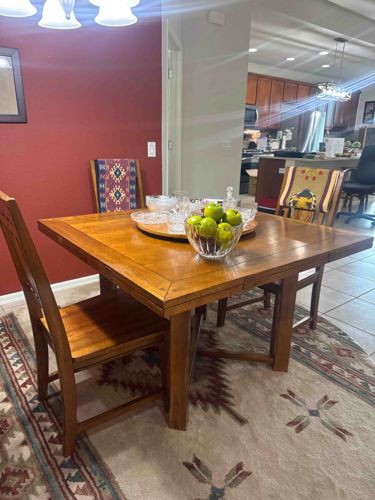
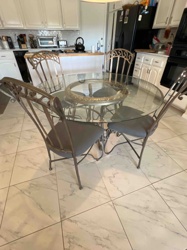
This item is a square wooden dining table, likely made of solid hardwood such as oak or maple, given its warm, medium-brown tone and visible grain patterns. The finish appears to be a satin or semi-gloss lacquer, providing a subtle sheen and protecting the wood. The table features a classic, somewhat rustic design with clean lines. The tabletop consists of a central panel and a perimeter border, suggesting it might be either a single solid piece with decorative routing or a piece with expansion capabilities, although no leaf inserts are visible in this view. The legs are robust and straight, providing a sturdy foundation. The overall construction appears well-made, indicating good craftsmanship, with visible joints suggesting traditional woodworking techniques. There are no obvious signs of significant damage such as deep scratches, gouges, or cracks, but typical wear consistent with regular use is likely present on the tabletop surface, though not clearly discernible in the image. The chairs, not fully visible but partially shown, appear to match the table in wood type and finish, suggesting they are part of a coordinated dining set. One chair back shows an ornate carved design, while two others feature upholstered patterns in a southwestern or tribal style, suggesting a design aesthetic that could bridge traditional and eclectic tastes. The set likely dates from the late 20th to early 21st century, falling into a contemporary or transitional style period. No maker's marks or identifying stamps are visible.
AI Appraisal Report
Upon visual examination of the provided image, I assess this square wooden dining table with four matching chairs to be in good overall condition. The table appears to be crafted from a solid hardwood, possibly oak or maple, evidenced by its warm, medium-brown tone and visible grain. The satin or semi-gloss lacquer finish provides adequate protection, and while typical wear consistent with use is expected on the tabletop, no significant damage like deep gouges or cracks is discernible. The construction appears well-made, suggesting good craftsmanship through visible traditional joinery. The chairs, though partially obscured, match the table's wood and finish, forming a cohesive set. The eclectic chair designs, incorporating an ornate carving and southwestern/tribal upholstered patterns, suggest a transitional or contemporary style dating from the late 20th to early 21st century.
Market conditions for dining sets of this style are generally stable, with demand for well-constructed, solid wood pieces remaining consistent. This set falls into a readily available category, neither rare nor exceptionally unique, which impacts its upper valuation. Comparables in the secondary market for solid hardwood dining sets of this vintage and quality typically range from $500 to $1,200, depending heavily on brand recognition and precise condition. Without knowing the manufacturer, I am pricing it conservatively. The primary factors impacting value are the solid wood construction and the complete, matching set. Factors that limit value are the lack of a known maker, potentially common wood type, and the eclectic chair upholstery, which might not appeal to all buyers equally.
It is crucial to note the limitations of an appraisal based solely on images. While I can assess visible condition, authenticity regarding wood type (e.g., solid vs. veneer), specific craftsmanship details, and the extent of wear and tear cannot be definitively confirmed without an in-person examination. An in-person inspection would allow me to physically check for structural integrity, hidden damage, exact wood identification, and potential maker's marks not visible in the photo. Provenance documentation, if available, would also aid in confirming history and potentially a manufacturer, which could adjust the valuation. Scientific testing is not typically required for items of this nature unless there's a specific question regarding wood origin or finishes.