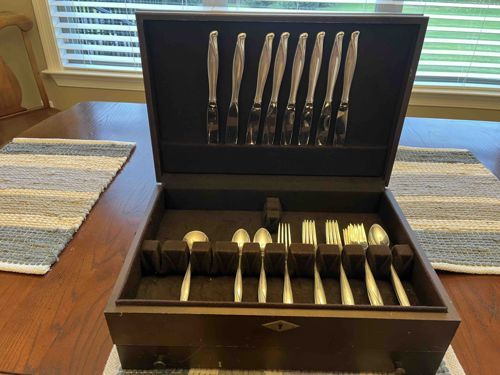
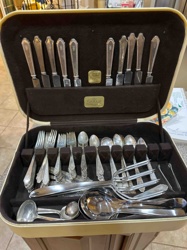
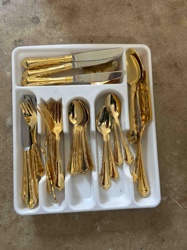
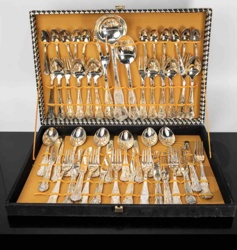
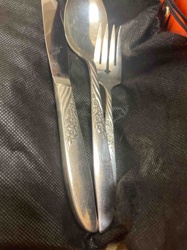
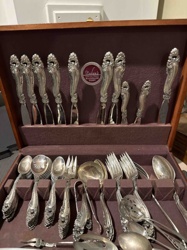
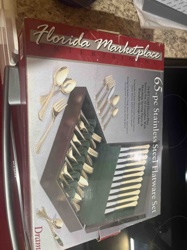
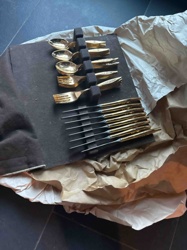
8 place setting...5 pieces to reach setting but only 6 long teaspoons
These notes were written by the person who submitted this item. Appraiser.AI has not verified them, and the AI's identification and estimate may rely on them.
AI Estimated Value
Not an official valuation
$100-200
AI estimate as of October 24, 2025 · verify with a professional before acting
AI-Generated · Verify before acting
Everything on this page is generated by AI for informational purposes only. AI can make mistakes — the AI may misidentify items or misattribute them (artist, maker, brand, designer, origin, era). This is not an official valuation and should not be used for insurance, sale, tax, estate, legal, or lending purposes — or any decision requiring a certified appraisal. It is not an authoritative claim about any person, brand, or rights holder — do not share or rely on it as a factual statement about a third party. Always consult qualified professionals before making financial decisions.
This analysis also relies on unverified notes provided by the user, which may be incomplete or inaccurate and could affect the result.
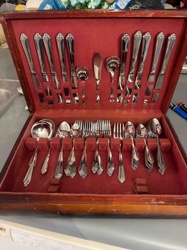
This item is a complete silverware set, likely silver-plated or stainless steel, housed within a dark stained wooden canteen. The set appears to be a Mid-Century Modern style, characterized by its sleek, unadorned handles with a subtle, curved design. The canteen itself is a rectangular box, possibly walnut or mahogany, with a hinged lid. The exterior of the canteen shows a rich, dark brown finish with a noticeable sheen, suggesting a polished surface, and features a brass or similar metal escutcheon on the front for a lock mechanism, though no key is visible. The interior of the canteen is lined with a dark, possibly velvet or felt, fabric, forming custom compartments and slots to securely hold each piece of silverware. The lid's interior also has a similar dark lining, with a top tray holding eight knives. The bottom section of the canteen is organized with dividers, holding forks and spoons. The set consists of 8 place settings, with each place setting comprising 5 pieces (a total of 40 pieces for the basic setting). Specifically, the visible components include eight knives with modern-shaped blades and handles, a substantial number of dinner forks, salad forks, soup spoons, and a stated six long teaspoons, which is fewer than a full 8-place setting would typically require. The silverware itself exhibits a bright, reflective surface, indicating good polish and maintenance. There are no obvious signs of heavy tarnish, significant scratches, or damage visible from the image, suggesting the set is in good to very good condition. The craftsmanship of the canteen appears solid, designed to protect and display the flatware. The uniform design of all the pieces indicates they are part of a matching set. The streamlined form and lack of extensive ornamentation point towards a mid-20th century aesthetic.
AI Appraisal Report
Based on my visual examination of the provided image, this Mid-Century Modern silverware set in a wooden canteen appears to be in good to very good condition. The silverware exhibits a bright, reflective surface, showing good maintenance with no visible heavy tarnish or significant scratches. The wooden canteen is well-preserved, featuring a rich, dark finish and intact lining, designed to protect and organize the set. Its sleek, unadorned handles align perfectly with the mid-20th century aesthetic, suggesting authenticity in style. However, without a physical inspection, it's impossible to definitively confirm the material (silver-plated vs. stainless steel) or manufacturer, which significantly impacts value.
Market conditions for vintage silverware sets are moderate. While there's a niche demand for complete, stylish Mid-Century Modern sets, particularly those in their original canteens, the secondary market is generally not robust for non-sterling silver. The discrepancy in the number of long teaspoons (6 instead of 8 for an 8-place setting) slightly diminishes its value as a complete set. Comparable silver-plated or high-quality stainless steel sets in this condition typically retail from $75 to $250. True rarity is low unless it's a specific, highly sought-after designer or manufacturer, which is not discernible from the image. For full authentication and a more precise valuation, I would need an in-person examination to check for hallmarks, assess the metal composition (e.g., sterling silver vs. plated), and thoroughly inspect for wear not visible in photographs. Provenance documentation would also add significant value.