AI estimate as of December 13, 2025 · verify with a professional before acting
AI-Generated · Verify before acting
Everything on this page is generated by AI for informational purposes only. AI can make mistakes — the AI may misidentify items or misattribute them (artist, maker, brand, designer, origin, era). This is not an official valuation and should not be used for insurance, sale, tax, estate, legal, or lending purposes — or any decision requiring a certified appraisal. It is not an authoritative claim about any person, brand, or rights holder — do not share or rely on it as a factual statement about a third party. Always consult qualified professionals before making financial decisions.
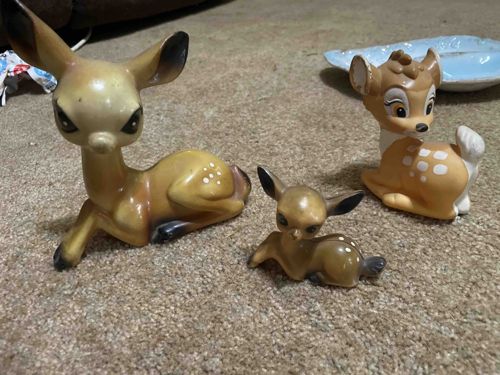
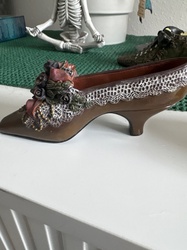
This collection consists of three vintage ceramic figurines depicting fawns, likely inspired by the Disney character Bambi. The central and largest figurine is a fawn in a recumbent or lying position, characterized by a light brown body with darker brown shading, particularly on the legs and around the face. It features dark black eyes with prominent white highlight dots, and black ears. White spots are painted on its back. The glaze appears glossy but shows some signs of wear, including potential discoloration or dirt accumulation, particularly noticeable on the face and around the eyes, suggesting a milky or yellowed hue. The construction is ceramic, possibly bisque fired and then glazed. The smaller figurine, also a fawn, is similarly colored and posed, with a slightly darker overall tone and less distinct features due to its size. It also has white spots on its back and black ears and hooves. The smallest fawn appears to be a baby deer. The third figurine, positioned to the right, clearly represents Bambi, identified by its distinctive facial features including expressive eyes, a small tuft of hair on its head, and lighter underparts with white spots on its back. This Bambi figure appears to have a more whimsical, animated style compared to the other two, with a pronounced white belly and tail. All figures exhibit a glossy finish, typical of ceramic figurines from the mid-20th century. Visible condition issues include general surface grime and possible paint loss on some areas, particularly the tips of the ears and hooves, although no significant chips or cracks are immediately apparent. The style suggests an age from the mid-century modern period, possibly 1950s-1970s, aligning with the introduction and popularity of Disney merchandise. The craftsmanship is typical of mass-produced ceramic decor items from that era, with hand-painted details.
AI Appraisal Report
Based on my visual examination of the provided image, this collection of three vintage ceramic fawn figurines, likely inspired by Disney's Bambi, appears to be in good vintage condition with typical signs of age. The largest fawn shows some surface grime and possible discoloration around the face and eyes, which could be cleaned. The gloss finish is evident across all pieces, consistent with mid-20th-century ceramic ware. I do not observe any significant chips, cracks, or repairs from the image, though minor paint loss on ear tips and hooves is noted. Authenticity as mass-produced decorative items from the 1950s-1970s seems reasonable given the style and craftsmanship.
Market conditions for vintage ceramic animal figurines, particularly those not directly branded or widely recognized as high-end collectibles, are generally moderate. While Disney-inspired items often hold a premium, these appear to be general fawn figurines rather than officially licensed Bambi merchandise, which would significantly impact value. Comparable items in similar condition typically sell in the $15-30 range per piece. There isn't significant rarity associated with these types of mass-produced ceramic decors. Demand is present among collectors of vintage kitsch and animal figurines, but it's not a high-demand market segment.
Key factors impacting value include the potential for cleaning to improve appearance, confirmation of no hidden damage, and the distinction between 'Bambi-inspired' and officially licensed Disney products. A major limitation of this appraisal is the reliance on images alone. For full authentication and a definitive assessment of condition, an in-person examination is crucial to detect hairline cracks, glaze inconsistencies, hidden repairs, and accurately assess the true extent of discoloration and wear. Provenance documentation or maker's marks, if present, would also be invaluable for authentication, but are not visible in the provided image.