AI Appraisal Estimate

AI-generated estimates · not official valuations

From the user

What was submitted

Photo and notes provided by the user — not generated by AI

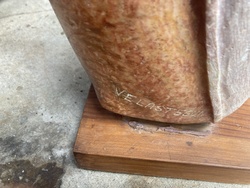
Submitted item photo
Submitted photo · May 26, 2026

User's notes

No additional notes provided.

AI analysis below

AI appraisal

AI analysis & estimate

AI-Generated · Verify before acting

Everything below is generated by AI for informational purposes only. AI can make mistakes — the AI may misidentify items or misattribute them (artist, maker, brand, designer, origin, era). This is not an official valuation and should not be used for insurance, sale, tax, estate, legal, or lending purposes — or any decision requiring a certified appraisal. It is not an authoritative claim about any person, brand, or rights holder — do not share or rely on it as a factual statement about a third party. Always consult qualified professionals before making financial decisions.

Read the full disclaimer

AI Identification

·Not independently authenticated·Verify before acting

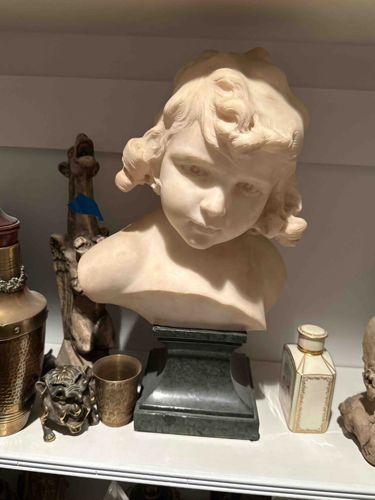
Late 19th Century Carved Alabaster Bust of a Young Child

Fine Art / Sculpture

AI Estimated Value

·Not an official valuation·Verify before acting

$400 - $600 USD

As of May 26, 2026

AI Item Analysis

·AI can make mistakes·Verify before acting
This is a fine neoclassical style bust depicting the head and shoulders of a young child, likely a young girl, executed in carved white alabaster. The child is portrayed with a gentle, downward-tilted gaze and a faint smile, featuring soft, cherubic facial features and elaborate curly hair that falls around the face and shoulders. The hair is intricately carved with significant depth, suggesting high-quality craftsmanship characteristic of Italian workshops during the Victorian or Belle Époque eras (circa 1880-1920). The alabaster exhibits a warm, translucent quality with natural veining in subtle yellowish tones. The bust is mounted on a contrasting square-stepped socle pedestal base, which appears to be carved from a dark green serpentinite or marble with mottled black and green inclusions. Physically, the piece shows areas of surface grime and light dust accumulation, particularly in the deep crevices of the hair. There is a visible hairline fracture or deep scratch on the child's right shoulder and minor surface pitting throughout, consistent with the soft nature of alabaster. The overall condition is good, showing expected age-related patina without significant structural losses to the facial features or the base.
AI Appraisal Report

·AI can make mistakes·Verify before acting
Upon visual examination of this Late 19th Century carved alabaster bust, I have determined it to be a charming example of the Neoclassical revival style popular in Continental Europe, particularly Italy, between 1890 and 1910. The craftsmanship is competent, particularly in the deep undercutting of the curly hair, which creates a lovely play of light and shadow characteristic of Italian workshop production intended for the Grand Tour trade. The contrasting green serpentinite socle adds a desirable decorative touch, elevating the piece above standard monochromatic sculptures. Condition is the primary limiting factor for value here. Alabaster is a notoriously soft stone (1.5-2 on the Mohs scale), making it susceptible to scratches and chemical weathering. I note significant surface grime and dust in the interstices of the carving, which dulls the natural translucency of the stone. More critically, the visible hairline fracture or deep scratch on the right shoulder and uniform surface pitting detract from the pristine finish collectors often seek. While the structural integrity appears sound, professional cleaning would be required to restore its original luster. Market demand for anonymous Victorian-era alabaster busts has softened in recent years, with values trending downward compared to signed marble equivalents. Without a signature or foundry mark visible in the provided images, this piece must be evaluated as a decorative object rather than a fine artwork by a listed master. To confirm a higher value tier, I would need to physically inspect the reverse for incised signatures and examine the joinery between the bust and the base for restoration evidence. Currently, it compares to similar unsigned Italian alabaster busts sold at regional auction houses in the $400 - $600 range.

Get your items appraised

Instant estimates of your treasures with AI-powered appraisals

Browse More Appraisals