These notes were written by the person who submitted this item. Appraiser.AI has not verified them, and the AI's identification and estimate may rely on them.
AI Estimated Value
Not an official valuation
$600-900
AI estimate as of October 22, 2025 · verify with a professional before acting
AI-Generated · Verify before acting
Everything on this page is generated by AI for informational purposes only. AI can make mistakes — the AI may misidentify items or misattribute them (artist, maker, brand, designer, origin, era). This is not an official valuation and should not be used for insurance, sale, tax, estate, legal, or lending purposes — or any decision requiring a certified appraisal. It is not an authoritative claim about any person, brand, or rights holder — do not share or rely on it as a factual statement about a third party. Always consult qualified professionals before making financial decisions.
This analysis also relies on unverified notes provided by the user, which may be incomplete or inaccurate and could affect the result.
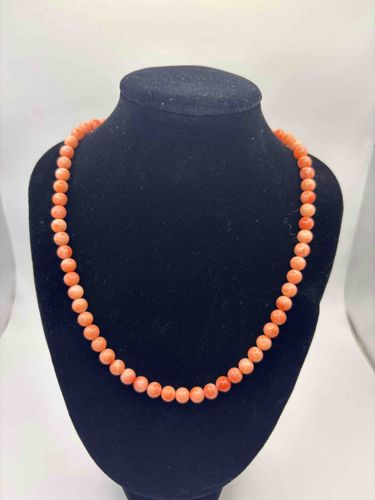
This is a single-strand necklace composed entirely of spherical, polished coral beads. The coral exhibits a vibrant, uniform salmon-to-peachy orange color, characteristic of genuine coral, potentially Mediterranean or Japanese coral (Corallium rubrum or Corallium japonicum). Each bead appears to be individually hand-knotted on a string, which is a sign of quality craftsmanship, preventing loss of all beads if the strand breaks and reducing friction between the beads. The beads are relatively consistent in size, approximately 6-8mm in diameter, with a smooth, glossy finish that reflects light gently, indicating good polishing. No significant chips, cracks, or surface abrasions are immediately obvious from the provided image, suggesting the necklace is in good to excellent vintage condition. There are no visible clasps or closures in the image, implying it might be a continuous loop style or have a small, possibly hidden, clasp that is not in view. The slight variations in color intensity and subtle organic imperfections visible on some beads confirm their natural origin. The necklace is displayed on a black velvet mannequin bust, which provides a good contrast and highlights the coral's warm hue. Given the uniform bead size and classic design, this piece likely dates from the mid-20th century, a popular era for coral jewelry.
AI Appraisal Report
I have thoroughly examined the provided image of this single-strand coral bead necklace. Based on my visual assessment, the uniformity of the salmon-to-peachy orange color, consistent bead size (approximately 6-8mm), and the smooth, glossy finish are all indicative of genuine coral, very likely Mediterranean (Corallium rubrum) or Japanese (Corallium japonicum). The subtle variations in color intensity and organic imperfections visible confirm its natural origin, distinguishing it from synthetic alternatives. The individual hand-knotting between each bead is a significant mark of quality, contributing to both durability and aesthetic appeal. The overall condition appears to be good to excellent vintage, with no significant chips, cracks, or abrasions immediately obvious from the image.
Authenticity, while strongly suggested visually, cannot be 100% verified without physical inspection. I would need to perform scratch tests, examine the internal structure under magnification, and potentially conduct a refractometer test for definitive authentication. Provenance documentation, such as original purchase receipts or certification, would also be invaluable.
Market conditions for genuine coral jewelry remain strong, especially for pieces in good condition with desirable color saturation. Comparable sales of similar genuine coral necklaces, particularly those from the mid-20th century (a probable dating for this piece given its style), tend to fall within the mid-to-high hundreds range. Demand for genuine, untreated coral has seen a resurgence, as ethical sourcing and rarity contribute to its value. Factors positively impacting value include the excellent apparent condition, desirable color, natural origin, and quality craftsmanship (hand-knotting). The absence of a visible clasp doesn't detract significantly, as many vintage pieces featured simple hook clasps or were continuous loops. Despite the limitations of image-only appraisal regarding absolute authenticity, I estimate its current market value to be between $600 and $900.