These notes were written by the person who submitted this item. Appraiser.AI has not verified them, and the AI's identification and estimate may rely on them.
AI Estimated Value
Not an official valuation
$5 - $15
AI estimate as of October 15, 2025 · verify with a professional before acting
AI-Generated · Verify before acting
Everything on this page is generated by AI for informational purposes only. AI can make mistakes — the AI may misidentify items or misattribute them (artist, maker, brand, designer, origin, era). This is not an official valuation and should not be used for insurance, sale, tax, estate, legal, or lending purposes — or any decision requiring a certified appraisal. It is not an authoritative claim about any person, brand, or rights holder — do not share or rely on it as a factual statement about a third party. Always consult qualified professionals before making financial decisions.
This analysis also relies on unverified notes provided by the user, which may be incomplete or inaccurate and could affect the result.
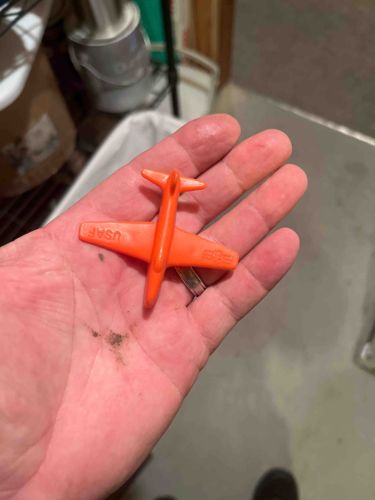
This is a small, molded plastic toy airplane, rendered in a striking bright orange color. The item is approximately 3-4 inches in length, designed in the style of a jet trainer aircraft, specifically resembling a Lockheed T-33 Shooting Star due to its distinct wing shape, fuselage, and tail structure, including the prominent tip tanks on the wings. It is a single-piece molded construction, suggesting it was produced as a promotional item, a gumball machine prize, or a simple children's toy.
One of the most notable features is the raised text molded onto the top surface of the left wing, which clearly reads "USAF", indicating a potential connection to the United States Air Force or a souvenir from an aviation-themed event. The right wing also has molded text, although it is slightly less clear in the image, possibly showing 'T-33' or a similar designation. The plastic material appears consistent throughout, showing a uniform bright orange hue. There are no visible moving parts or detachable components.
The overall condition appears good for a toy of this type, with no obvious breaks, cracks, or significant chips. There is some minor surface wear and possibly light scratching, as would be expected from a used plastic item. No discernible maker's mark or specific manufacturing details are visible beyond the 'USAF' inscription. Given its simple, molded construction and plastic material, it likely dates from the mid-to-late 20th century, a common period for such promotional toys. The craftsmanship is basic but effective for its intended purpose as a small, inexpensive toy.
AI Appraisal Report
Based on my visual examination of the provided image, this small, bright orange plastic toy airplane is a molded replica, clearly designed to evoke a Lockheed T-33 Shooting Star. The raised 'USAF' text on the left wing is a key identifier, strongly suggesting its origin as a promotional item or a souvenir from an aviation-related context. The general condition appears good for a vintage plastic toy, with no visible breaks or significant damage, only minor surface wear consistent with age and use.
Market conditions for such items are generally modest. These types of single-piece molded plastic toys, often from gumball machines or sold as inexpensive novelties, do not typically command high prices. Comparable items, even those with specific military markings or historical significance, rarely exceed $20 unless they are part of a rare set, in pristine condition with original packaging, or exceptionally large/detailed. Demand is primarily from niche collectors of vintage plastic toys or aviation memorabilia, but the market is not robust for individual common examples.
Factors significantly impacting its value include its simple construction, lack of intricate detail, and the common material. While the 'USAF' inscription adds a touch of authenticity to its promotional nature, it doesn't elevate its rarity significantly. Without a manufacturer's mark, specific date, or clear connection to a major event or company, its provenance is limited.
It is important to note the limitations of appraising from images alone. A physical examination would allow me to thoroughly inspect for subtle cracks, precise wear patterns, and feel the plastic quality. Confirmation of the exact text on the right wing would also be possible. Further provenance documentation, such as original packaging or historical context, would be required for full authentication beyond what is visible, though for an item of this type, such documentation is rarely available or necessary for valuation.