AI estimate as of November 20, 2025 · verify with a professional before acting
AI-Generated · Verify before acting
Everything on this page is generated by AI for informational purposes only. AI can make mistakes — the AI may misidentify items or misattribute them (artist, maker, brand, designer, origin, era). This is not an official valuation and should not be used for insurance, sale, tax, estate, legal, or lending purposes — or any decision requiring a certified appraisal. It is not an authoritative claim about any person, brand, or rights holder — do not share or rely on it as a factual statement about a third party. Always consult qualified professionals before making financial decisions.
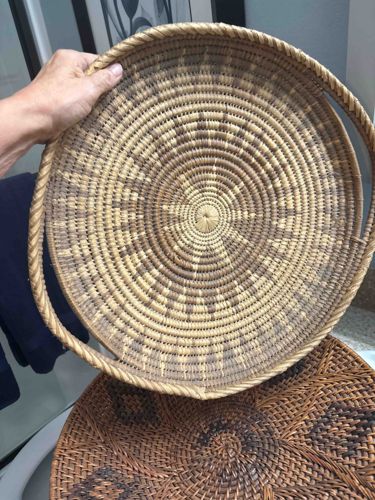
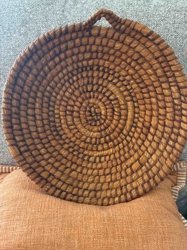
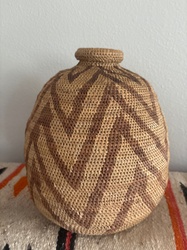
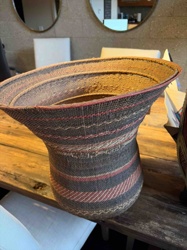
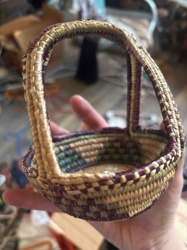
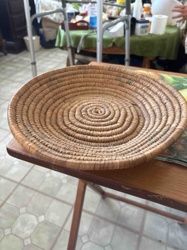
This is a circular, coiled woven basket tray, likely crafted from natural plant fibers such as raffia, palm leaves, or similar reeds. The predominant colors are natural, light tan, and a contrasting darker brown or black, creating a distinct patterned design. The central motif radiates outwards in concentric circles, featuring distinct triangular or chevron-like patterns in the darker fiber, which alternate with the lighter natural material. This patterning suggests a traditional or tribal aesthetic. The weaving technique appears to be a tight coiling method, indicating careful and skilled hand-craftsmanship. The rim of the tray is finished with a robust, braided or tightly wrapped edge that extends to form two integrated loop handles on opposite sides, allowing for easy carrying. The handles appear sturdy and well-formed, seamlessly blending into the tray's overall structure. The condition appears good, with a natural patina consistent with age and use, visible as a slight dulling or darkening of the fibers, particularly in the darker areas. There are no immediately apparent signs of significant damage such as breaks, unraveling, or major discoloration beyond natural aging. The quality of the weave is fine and consistent, suggesting a handcrafted item of good quality. This type of basketry can originate from various global cultures known for their weaving traditions, making an exact age or regional origin difficult to determine without additional context or maker's marks, which are not visible. It appears to be a vintage or antique piece given the muted tones and uniform appearance of wear.
AI Appraisal Report
Upon visual examination of the provided image, I assess this coiled woven basket tray as being in good vintage condition. The tight coiling method and consistent fiber work indicate a skilled hand-craftsmanship. I observe a natural patina consistent with age and use, particularly the slight dulling in the darker fibers, which contributes to its vintage aesthetic rather than detracting from it. The integrated loop handles appear sturdy and well-formed, essential for its functionality. Authenticity, based solely on visual cues, suggests a genuine handcrafted item from a culture with strong basketry traditions.
Market conditions for vintage ethnic or handcrafted basketry are generally stable, with demand driven by interior decorators, collectors of folk art, and individuals seeking unique, sustainably sourced home decor. Comparable items of similar quality, size, and age-appropriate wear from various global traditions (e.g., African, Native American, or Pacific Islander) typically fetch prices in the midrange. While not exceedingly rare, a well-preserved and aesthetically pleasing piece like this holds consistent demand. Key factors impacting its value positively include its good condition, the intricate patterned design, and the apparent quality of its construction.
A limitation in definitively authenticating without physical inspection is the inability to assess fiber type, precise weave density, and any hidden repairs or damage. An in-person examination would allow for a tactile assessment of material, weave tension, and a more thorough inspection for any signs of restoration or damage. Provenance documentation, such as collection history or details of origin, would significantly enhance authentication and potentially value, as would scientific testing of fibers if a specific regional origin were claimed.