AI Appraisal Estimate

AI-generated estimates · not official valuations

From the user

What was submitted

Photo and notes provided by the user — not generated by AI

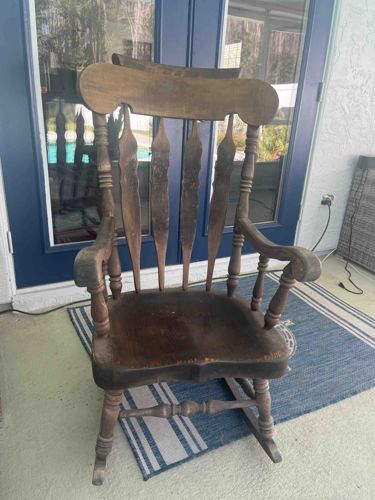
Submitted item photo
Submitted photo · May 26, 2026

User's notes

No additional notes provided.

AI analysis below

AI appraisal

AI analysis & estimate

AI-Generated · Verify before acting

Everything below is generated by AI for informational purposes only. AI can make mistakes — the AI may misidentify items or misattribute them (artist, maker, brand, designer, origin, era). This is not an official valuation and should not be used for insurance, sale, tax, estate, legal, or lending purposes — or any decision requiring a certified appraisal. It is not an authoritative claim about any person, brand, or rights holder — do not share or rely on it as a factual statement about a third party. Always consult qualified professionals before making financial decisions.

Read the full disclaimer

AI Identification

·Not independently authenticated·Verify before acting

Antique American Splat-Back Rocking Chair

Antique Furniture

AI Estimated Value

·Not an official valuation·Verify before acting

$250 - $400

As of May 26, 2026

AI Item Analysis

·AI can make mistakes·Verify before acting
This is an antique wooden rocking chair, likely American in origin, showcasing a blend of Windsor-influenced and Early American styles. The chair is constructed from solid wood, featuring a dark oak or walnut-stained finish that has aged significantly. It boasts a distinctive high back with four fiddle-shaped or 'shield' vertical splats positioned between two turned stiles. The top rail is a wide, horizontally curved crest rail. The curved armrests are supported by turned spindles that match the leg design. The seat is contoured and remarkably thick, indicating a sturdy, hand-finished construction typical of late 19th-century craftsmanship. The base consists of four robustly turned legs joined by stretchers, all mounted on traditional wooden rockers. Condition-wise, the piece shows extensive signs of use and age-related wear, including significant finish loss on the splats, arms, and seat, along with surface abrasions and a heavy patina. There are visible scuffs and indentations on the seat edge and rockers, suggesting many decades of regular use. No specific maker's marks are visible, but the construction techniques suggest a utilitarian piece from the mid-to-late 1800s. The overall quality reflects a durable, functional piece of historical domestic furniture.
AI Appraisal Report

·AI can make mistakes·Verify before acting
Based on my visual examination of this American splat-back rocking chair, I have identified it as a utilitarian domestic piece dating approximately from 1860 to 1890. The construction features—notably the thick-contoured seat and the fiddle-shaped splats—are characteristic of mass-produced yet high-quality transitional furniture from the mid-to-late Victorian era. The heavy wear on the arms and seat confirms decades of use, providing a genuine patina that collectors of 'primitive' or 'country' Americana often find desirable. However, the significant finish loss and abrasions on the crest rail and splats detract from its value compared to examples in 'collector grade' condition. The current market for late 19th-century American rockers is relatively soft, as younger collectors increasingly favor mid-century modern or smaller-scale items. Similar 'Fiddle-back' or 'Shield-back' rockers frequently sell at regional auctions within the $200 to $500 range depending on the specific wood species and provenance. The absence of a maker’s mark suggests this was produced by one of the numerous regional manufacturers in the Midwest or Northeast, which limits its rarity. Final authentication is limited by the digital format of this assessment. To confirm the absence of modern machine-cut screws or synthetic glues, an in-person physical inspection of the joinery and underside is required. I would also need to examine the wood grain under the finish to determine if it is solid walnut or stained oak, as solid walnut would command the higher end of the estimate. Detailed provenance or family history could further enhance the value, but based on visual evidence alone, this remains a sturdy, authentic piece of historical American furniture.

Get your items appraised

Instant estimates of your treasures with AI-powered appraisals

Browse More Appraisals