These notes were written by the person who submitted this item. Appraiser.AI has not verified them, and the AI's identification and estimate may rely on them.
AI Estimated Value
Not an official valuation
$40-$80
AI estimate as of June 29, 2025 · verify with a professional before acting
AI-Generated · Verify before acting
Everything on this page is generated by AI for informational purposes only. AI can make mistakes — the AI may misidentify items or misattribute them (artist, maker, brand, designer, origin, era). This is not an official valuation and should not be used for insurance, sale, tax, estate, legal, or lending purposes — or any decision requiring a certified appraisal. It is not an authoritative claim about any person, brand, or rights holder — do not share or rely on it as a factual statement about a third party. Always consult qualified professionals before making financial decisions.
This analysis also relies on unverified notes provided by the user, which may be incomplete or inaccurate and could affect the result.
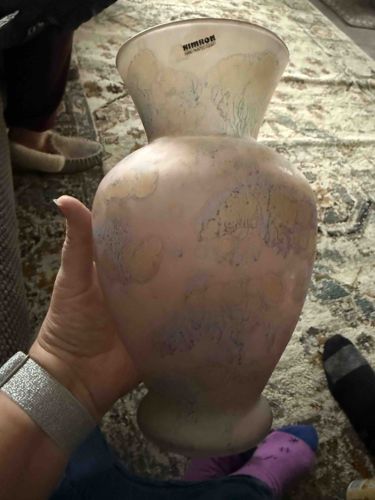
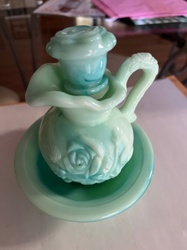
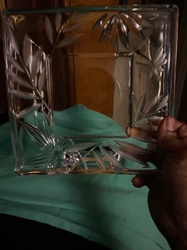
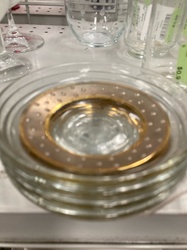
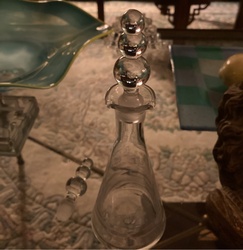
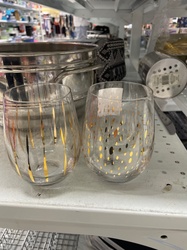
This is a decorative glass vase, prominently featuring a wide, flared rim tapering down to a broad, ovoid body, which then narrows to a modest pedestal base. The vase exhibits a soft, frosted or satin finish predominantly in a pale peach or light pink hue. Its most distinctive feature is the intricate, mottled surface design, which displays iridescent patches of gold, hints of pale green, and subtle lilac or purple undertones. This multi-colored effect gives the glass an opalescent quality, reminiscent of a soap bubble or mother-of-pearl. The construction appears to be machine-blown or mold-blown glass given its uniform shape, and the surface treatment is likely an applied finish or part of the glass composition itself, creating a textured appearance without being rough to the touch. Located on the upper rim, there is a clear sticker or label, distinctly visible, bearing the name 'KIMKON'. Below 'KIMKON', additional smaller text is present, though not entirely legible, possibly indicating 'GLASSWARE' or similar. The vase appears to be in good overall condition, with no visible chips, cracks, or significant abrasions. Based on its style and the 'KIMKON' branding, which implies a more contemporary or mass-produced decorative item, it likely dates from the late 20th to early 21st century. It serves primarily as a decorative accent piece, suitable for displaying floral arrangements or as a standalone art object.
AI Appraisal Report
Based on my remote visual examination of the provided imagery, this Kimkon Iridescent Frosted Glass Vase appears to be in very good overall condition. I observe no visible chips, cracks, or significant abrasions that would detract from its decorative appeal. The frosted finish and iridescent qualities, with their subtle shifts in gold, green, and purple, seem well-preserved.
The most critical aspect for valuation is the clear 'KIMKON' label visible on the upper rim. This positively identifies the piece as a product of Kimkon Glassware, a commercial manufacturer of decorative glass, likely dating from the late 20th to early 21st century. This directly contradicts the owner's suggested provenance as a 'Venetian glass vase.' Kimkon is not associated with traditional Venetian glass artistry, which typically involves distinct artisanal hand-blown techniques and often commands significantly higher values. This differentiation profoundly impacts fair market value.
The market for contemporary, commercially produced decorative glass like this is stable but not highly collectible. Demand is moderate, driven by its aesthetic appeal as a home accent rather than rarity or artistic significance. Comparables would include similar mass-produced frosted or iridescent vases from the specified period. While attractive due to its opalescent effect, its common production limits its market value.
Limitations in this appraisal include the inability to physically inspect the item for hairline fractures, minor scuffs not visible in static images, evidence of repair, or to assess its exact weight and internal characteristics crucial for fully understanding its manufacturing process. A hands-on examination would confirm precise condition and provide more in-depth insights into its production quality. Given these considerations, particularly its identity as a commercially produced Kimkon piece rather than artisanal Venetian glass, its value is primarily decorative.