AI Appraisal Estimate

AI-generated estimates · not official valuations

From the user

What was submitted

Photo and notes provided by the user — not generated by AI

Submitted item photo
Submitted photo · May 27, 2026

User's notes

No additional notes provided.

AI analysis below

AI appraisal

AI analysis & estimate

AI-Generated · Verify before acting

Everything below is generated by AI for informational purposes only. AI can make mistakes — the AI may misidentify items or misattribute them (artist, maker, brand, designer, origin, era). This is not an official valuation and should not be used for insurance, sale, tax, estate, legal, or lending purposes — or any decision requiring a certified appraisal. It is not an authoritative claim about any person, brand, or rights holder — do not share or rely on it as a factual statement about a third party. Always consult qualified professionals before making financial decisions.

Read the full disclaimer

AI Identification

·Not independently authenticated·Verify before acting

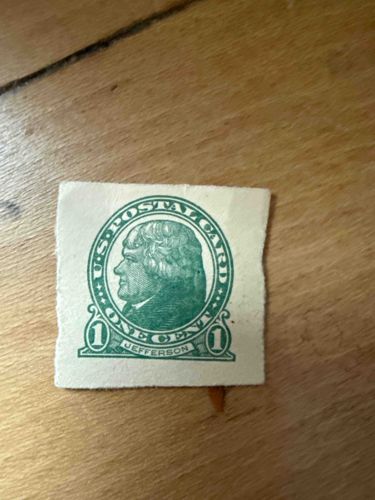
Thomas Jefferson 1-Cent US Postal Card Cut Square

Philatelic / Postal Stationery

AI Estimated Value

·Not an official valuation·Verify before acting

$0.50 - $2.00

As of May 27, 2026

AI Item Analysis

·AI can make mistakes·Verify before acting
This item is a 'cut square' segment featuring a 1-cent Thomas Jefferson green indicative stamp, originally printed directly onto a United States Postal Card. This specific design and denomination were widely produced in the late 19th and early 20th centuries, notably around the 1880s to early 1900s. The central image features a profile portrait of Thomas Jefferson facing left, enclosed within an oval frame inscribed with 'U.S. POSTAL CARD' at the top and 'ONE CENT' along the bottom ribbon. The numeral '1' appears in small medallions on both the left and right corners. The printing is in a distinct green ink on a cream-colored, heavyweight cardstock. Regarding condition, this item has been roughly hand-cut from its original postal card, resulting in irregular, jagged edges rather than straight, clean lines. This significantly impacts its value as a philatelic specimen, as 'full cards' or 'neatly cut squares' are preferred by collectors. There is a visible crease or fold mark running vertically near the right edge of the image. The paper shows natural toning and slight foxing consistent with age. There is no visible postmark, suggesting this was cut from an unused card. The engraving remains sharp, showing the intricate lines of Jefferson's hair and the decorative scrollwork typical of the Bureau of Engraving and Printing's era-specific craftsmanship.
AI Appraisal Report

·AI can make mistakes·Verify before acting
I have examined the digital image of the 1-cent Thomas Jefferson green postal card cut square. From a visual standpoint, the item depicts the classic Jefferson design used primarily on the UX7 (1881) and UX9 (1885) series. While the engraving appears sharp and consistent with the craftsmanship of the Bureau of Engraving and Printing, the physical condition is poor for a philatelic specimen. The irregular, jagged edges indicate a crude separation from the original card; in the world of postal stationery, intrinsic value is primarily tied to the 'Entire' card or at least a 'Full Corner' with wide, even margins. The vertical crease and visible foxing further diminish its grade. Because this is an extremely common issue (printed in the hundreds of millions) and the condition is substandard, there is virtually no demand from serious collectors for this specific piece. Most collectors would view this as a 'space filler' or a scrap. Comparisons for 'Entires' of this period in fine condition range from $5 to $15, making a damaged cut square negligible in value. Limitations: This appraisal is based solely on digital images. My assessment assumes the ink is the standard green pigment and the substrate is the period-correct cardstock. Full authentication would require an in-person examination to verify the paper's weight and weave, check for chemical alterations or artificial aging, and confirm the absence of a hidden hinge or repair. However, given the low market value, the cost of professional certification (e.g., PF or PSE) would significantly exceed the value of the item itself.

Get your items appraised

Instant estimates of your treasures with AI-powered appraisals

Browse More Appraisals