AI Appraisal Estimate

AI-generated estimates · not official valuations

From the user

What was submitted

Photo and notes provided by the user — not generated by AI

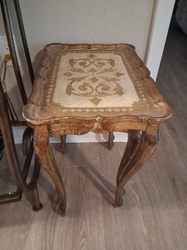
Submitted item photo
Submitted photo · June 3, 2026

User's notes

No additional notes provided.

AI analysis below

AI appraisal

AI analysis & estimate

AI-Generated · Verify before acting

Everything below is generated by AI for informational purposes only. AI can make mistakes — the AI may misidentify items or misattribute them (artist, maker, brand, designer, origin, era). This is not an official valuation and should not be used for insurance, sale, tax, estate, legal, or lending purposes — or any decision requiring a certified appraisal. It is not an authoritative claim about any person, brand, or rights holder — do not share or rely on it as a factual statement about a third party. Always consult qualified professionals before making financial decisions.

Read the full disclaimer

AI Identification

·Not independently authenticated·Verify before acting

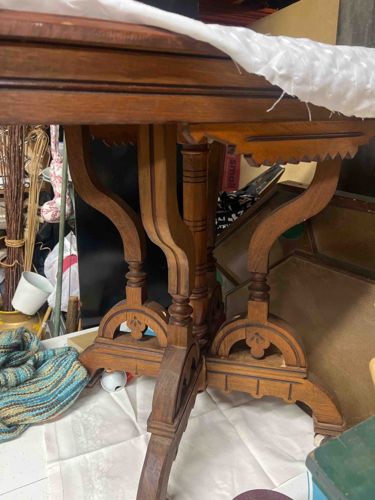
Eastlake Style Walnut Center or Lamp Table

Antique Furniture

AI Estimated Value

·Not an official valuation·Verify before acting

$450 - $650

As of June 3, 2026

AI Item Analysis

·AI can make mistakes·Verify before acting
This is an antique wooden table, likely a center or lamp table, crafted in the Victorian Eastlake style dating from approximately 1870 to 1890. The piece is constructed from walnut with a warm, medium-brown finish. It features a highly architectural and ornate base characteristic of the Aesthetic Movement, consisting of a central turned post surrounded by four elegant S-curved or lyre-shaped supports. These supports terminate in blocked feet at the floor. Notable decorative elements include incised geometric carvings, stylized floral or trefoil cutouts in the arching braces near the base, and a serrated 'sawtooth' or crenelated apron detail beneath the tabletop. The craftsmanship showcases the machine-aided but hand-finished precision typical of late 19th-century American furniture manufacturing. The piece appears to be in fair to good antique condition; there is visible surface wear, minor scuffing on the lower legs, and a dry patina suggesting the finish is original and may require light conservation. No maker's marks are immediately visible in the provided image, but the overall design is indicative of high-quality mass production from Northern furniture centers of the era such as Grand Rapids. The tabletop appears to have a molded edge, and the overall structural integrity seems sound despite being stored in a cluttered environment.
AI Appraisal Report

·AI can make mistakes·Verify before acting
I have carefully examined the visual properties of this walnut center table, which presents as a quintessential example of American Eastlake furniture from the late Victorian era (c. 1875-1885). The architectural integrity of the piece is notable, particularly the lyre-shaped supports and incised geometric carvings that exemplify the Aesthetic Movement's rejection of over-elaborate curves in favor of linear, 'honest' construction. The 'sawtooth' apron is a desirable stylistic flourish often attributed to high-quality manufacturers in the Ohio River Valley or Grand Rapids regions. The condition appears fair to good for its age. While I observe a healthy original patina, there is evidence of surface desiccation and minor abrasions on the blocked feet. The market for Victorian brown furniture has stabilized after a period of decline, with increased demand for smaller, functional accent pieces like lamp tables. Comparables for similar walnut tables in original condition typically realize between $400 and $700 at regional auctions and antique showrooms. Limitations: This appraisal is based solely on digital images. Without an in-person inspection, I cannot verify the stability of the joinery or detect hidden repairs. A physical examination is required to confirm the presence of maker’s marks or labels under the tabletop, which could significantly increase provenance value. Furthermore, examination under ultraviolet light would be necessary to determine if the finish is indeed original or a later 20th-century shellac restoration. Final authentication would require investigating the underside for period-appropriate tool marks (circular or straight saw marks) consistent with late 19th-century manufacturing.

Get your items appraised

Instant estimates of your treasures with AI-powered appraisals

Browse More Appraisals