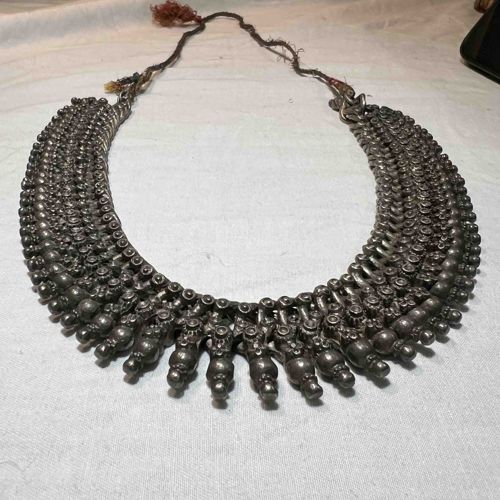
Item: Antique tribal handmade tear dropped pendant necklace Item dimensions: L30” x H1” x W1” Item materials: possibly silver or silver-toned alloy metal (heavy in weight) / Cord: Braided cord, metallic wire/thread, tassel fibers, metal band around tassel Location origin: Possibly tribal necklace from Central or South Asia
These notes were written by the person who submitted this item. Appraiser.AI has not verified them, and the AI's identification and estimate may rely on them.
AI Estimated Value
Not an official valuation
$250 - $400
AI estimate as of August 15, 2025 · verify with a professional before acting
AI-Generated · Verify before acting
Everything on this page is generated by AI for informational purposes only. AI can make mistakes — the AI may misidentify items or misattribute them (artist, maker, brand, designer, origin, era). This is not an official valuation and should not be used for insurance, sale, tax, estate, legal, or lending purposes — or any decision requiring a certified appraisal. It is not an authoritative claim about any person, brand, or rights holder — do not share or rely on it as a factual statement about a third party. Always consult qualified professionals before making financial decisions.
This analysis also relies on unverified notes provided by the user, which may be incomplete or inaccurate and could affect the result.
This is an antique tribal handmade necklace, likely originating from Central or South Asia, characterized by its substantial weight and intricate metalwork. The item measures approximately L30” x H1” x W1”. It features a broad, curved collar-like structure composed of numerous rows of tear-dropped or elongated spherical metal elements. These elements appear to be formed from a possibly silver or silver-toned alloy metal, exhibiting a dark, aged patina that suggests significant age and handling. Each individual metal piece is meticulously crafted, some appearing hollow or filigreed with small decorative motifs, indicating skilled craftsmanship. The construction involves a series of linked components, creating a flexible yet robust form. At the bottom edge of the metal collar, a fringe of larger, pendulous tear-dropped beads hangs, adding depth and movement to the design. The necklace is strung on a braided cord, which also incorporates metallic wire or thread, subtly enhancing its tribal aesthetic. One end of the cord features a small tassel made of fibers, secured by a metal band, further emphasizing its handcrafted nature. The visible condition suggests normal wear commensurate with antiquity, including surface scratches, minor dents, and a rich, uneven oxidation that contributes to its character. No specific maker's marks or signatures are readily discernible from the image, which is common for artisanal tribal pieces. The overall impression is one of genuine age and cultural significance, reflecting traditional jewelry-making techniques.
AI Appraisal Report
Based on my examination of the provided images and description, this antique tribal necklace exhibits characteristics consistent with pieces from Central or South Asia, possibly from regions like Afghanistan, Pakistan, or Rajasthan, India. The craftsmanship, featuring numerous handcrafted metal elements and a heavy, aged patina, suggests genuine antiquity and traditional artisanal production. The design, with its elaborate collar and fringe of teardrop pendants, is a classic tribal form. Its condition appears to be good for its age, showing wear, minor dents, and oxidation that are expected and actually contribute to its authenticity and character.
Market value for such pieces is influenced by material composition, age, provenance, and craftsmanship. Similar tribal necklaces made from silver-toned alloys (like alpaca, nickel silver, or mixed metals) typically have a strong decorative appeal. The primary value driver here is its aesthetic quality, apparent age, and the significant hand labor involved. Without confirmed provenance or a maker's mark, its value is primarily as a high-quality decorative and ethnographic artifact.
However, a definitive appraisal is limited without a physical inspection. I cannot confirm the exact metal content—whether it is a low-grade silver, a silver alloy, or a non-precious white metal—through images alone. A full authentication would require in-person examination, including scratch or acid testing of the metal to determine its composition and fineness. This is the most significant factor that could dramatically alter its value. Documentation of its origin or collection history would also substantially increase its worth.