These notes were written by the person who submitted this item. Appraiser.AI has not verified them, and the AI's identification and estimate may rely on them.
AI Estimated Value
Not an official valuation
$40 - $70
AI estimate as of September 29, 2025 · verify with a professional before acting
AI-Generated · Verify before acting
Everything on this page is generated by AI for informational purposes only. AI can make mistakes — the AI may misidentify items or misattribute them (artist, maker, brand, designer, origin, era). This is not an official valuation and should not be used for insurance, sale, tax, estate, legal, or lending purposes — or any decision requiring a certified appraisal. It is not an authoritative claim about any person, brand, or rights holder — do not share or rely on it as a factual statement about a third party. Always consult qualified professionals before making financial decisions.
This analysis also relies on unverified notes provided by the user, which may be incomplete or inaccurate and could affect the result.
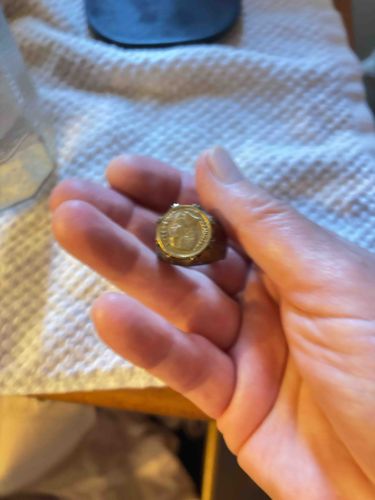
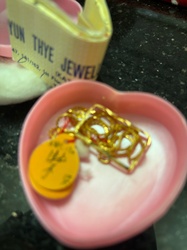
This item is a brass ring featuring an integrated coin as its central design element. The ring appears to be a signet-style ring, characterized by its broad, flat top where the coin is set. The material is consistently brass, exhibiting a warm, golden-yellow hue, though some areas may show slight discoloration or patina consistent with age and handling. The coin itself appears to be a small-denomination coin, possibly an older foreign currency or a commemorative medal, given the distinct portrait visible on its obverse. The portrait seems to be that of a regal figure, surrounded by a faint inscription or legend, likely the date or country of origin, though these details are largely illegible from the image. The coin is securely set within a raised bezel or frame, which is also brass. The band of the ring visible on the sides adjacent to the coin shows some decorative etching or casting, though the specific pattern is not clear due to the image resolution and angle. There are no overt signs of damage such as cracks or significant dents, but typical wear and tear consistent with a used piece of jewelry, such as minor scratches and surface abrasions, are likely present, contributing to its aged appearance. The craftsmanship appears to be functional and perhaps utilitarian rather than high-end fine jewelry, suggesting a possible 'trench art' or commemorative piece, dating likely from the mid-20th century. The overall feel suggests a robust construction, suitable for daily wear. The style indicates a more masculine or unisex design, popular in certain periods for expressing personal or cultural affiliations.
AI Appraisal Report
Based on my examination of the provided image and description, this brass coin ring appears to be in good, aged condition, exhibiting typical wear consistent with a mid-20th-century piece. The brass material shows a warm patina, and while minor scratches and surface abrasions are expected, there are no overt signs of significant damage. The coin, securely set in a bezel, features an illegible portrait and inscription, which limits definitive identification. The craftsmanship suggests a utilitarian or 'trench art' quality rather than high-end fine jewelry. Market conditions for such brass coin rings are generally modest. These items are often considered vintage costume jewelry or novelty pieces. Comparables typically sell in the $30-$80 range, depending on the specific coin, overall condition, and design intricacy. Demand is niche, primarily from collectors of militaria, vintage jewelry, or those interested in specific historical periods. Rarity is low as many similar items were produced. Factors impacting value negatively include the base metal (brass rather than a precious metal), the likely low intrinsic value of the integrated coin, and the functional rather than artistic craftsmanship. The illegibility of the coin's details also prevents identification of a potentially valuable or rare coin. Without physical examination, I cannot authenticate the coin's origin, specific denomination, or detect any hidden repairs or material inconsistencies. A full authentication would require in-person inspection to accurately identify the coin, assess the metal composition more precisely, and confirm the method of construction. Provenance documentation, if available, would also aid in verifying its history as 'trench art' or a specific commemorative piece.