AI estimate as of November 1, 2025 · verify with a professional before acting
AI-Generated · Verify before acting
Everything on this page is generated by AI for informational purposes only. AI can make mistakes — the AI may misidentify items or misattribute them (artist, maker, brand, designer, origin, era). This is not an official valuation and should not be used for insurance, sale, tax, estate, legal, or lending purposes — or any decision requiring a certified appraisal. It is not an authoritative claim about any person, brand, or rights holder — do not share or rely on it as a factual statement about a third party. Always consult qualified professionals before making financial decisions.
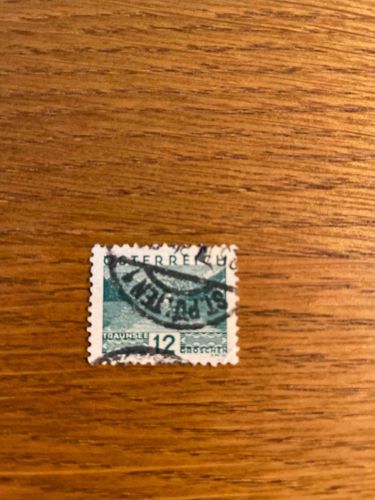
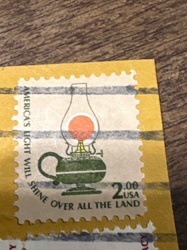
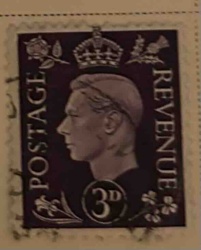
This is a small, rectangular postage stamp, approximately 2 cm wide and 1.5 cm tall, with a perforated edge typical of postage stamps. The primary color of the stamp appears to be a light teal or greenish-blue, with white borders and text. The country 'ÖSTERREICH' (Austria) is visible at the top edge of the stamp. At the bottom, the denomination '12' is clearly legible, followed by what appears to be 'GROSCHEN' although the full word is somewhat obscured by the cancellation mark. A prominent feature is the circular postmark or cancellation stamp, which is dark black and partially covers the stamp's design. The cancellation reads 'ST. PÖLTEN' in an arc, indicating the city where the stamp was cancelled. The date or other specific details within the cancellation are not fully discernible due to the angle and clarity of the image, but it appears to be a standard circular date stamp. The overall condition of the stamp shows some slight wear consistent with postal use, including the heavy cancellation and minor creasing or handling marks, particularly on the left side. The perforations appear largely intact, though individual perforations along the edges may have minor imperfections. The stamp is set against a wooden background, suggesting it might be part of a collection or simply laid out for inspection. Given the 'Groschen' denomination and the 'Österreich' country name, this stamp most likely dates from the First or Second Austrian Republic, possibly mid-20th century, but a more precise dating would require identification of the specific issue.
AI Appraisal Report
I have examined the provided image of this Austrian postage stamp with a St. Pölten cancellation. The stamp is a 12 Groschen denomination from Austria, likely dating from the mid-20th century, given the currency and country name. Visually, the condition is consistent with typical postal use. The perforations appear largely intact, but the heavy circular 'ST. PÖLTEN' cancellation, while authenticating its postal usage, significantly obscures the design and denomination, impacting its aesthetic appeal. There are also minor handling marks or creasing evident, particularly on the left side, which further detract from its condition. While the cancellation confirms it is a genuine used stamp, the exact date within the cancel is not discernible, which could limit specific issue identification without further research.
From a market perspective, this type of mid-century Austrian stamp in a common denomination and in used condition, especially with a heavy cancellation, generally commands a modest value. Unless this specific 12 Groschen issue is a known rarity or error (which is not suggested by the visual information), its value is likely low. Comparables for common Austrian definitive stamps from this era typically range from a few cents to a few dollars, depending on the specific issue, condition, and cancellation clarity.
Demand for such an item is generally limited to general collectors of Austrian philately or those specifically collecting cancellations from St. Pölten. Its rarity is low. The heavy cancellation is the primary factor impacting value negatively, as it obscures the stamp's design elements.
**Limitations:** Authentication of the stamp's specific issue and precise dating, as well as a definitive assessment of minor faults (e.g., thinning, repairs), cannot be fully determined from an image alone. An in-person examination would allow for a precise identification of the Scott or Michel catalog number, a detailed inspection of paper quality, gum (if present), and any potential hidden flaws, all of which could slightly adjust the valuation. Provenance documentation could also provide additional historical context, though it's unlikely to significantly impact the value of such a common item.