AI Appraisal Estimate

AI-generated estimates · not official valuations

From the user

What was submitted

Photo and notes provided by the user — not generated by AI

Submitted item photo
Submitted photo · May 28, 2026

User's notes

No additional notes provided.

AI analysis below

AI appraisal

AI analysis & estimate

AI-Generated · Verify before acting

Everything below is generated by AI for informational purposes only. AI can make mistakes — the AI may misidentify items or misattribute them (artist, maker, brand, designer, origin, era). This is not an official valuation and should not be used for insurance, sale, tax, estate, legal, or lending purposes — or any decision requiring a certified appraisal. It is not an authoritative claim about any person, brand, or rights holder — do not share or rely on it as a factual statement about a third party. Always consult qualified professionals before making financial decisions.

Read the full disclaimer

AI Identification

·Not independently authenticated·Verify before acting

Stone Bolo Tie

Jewelry

AI Estimated Value

·Not an official valuation·Verify before acting

$100-250

As of May 28, 2026

AI Item Analysis

·AI can make mistakes·Verify before acting
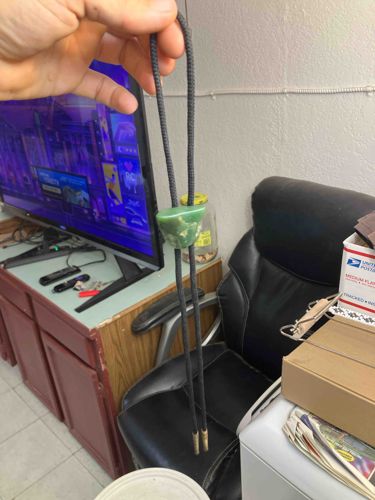
The item is a bolo tie, a type of neckwear traditionally associated with Western American attire. It features a prominent and irregularly shaped slide, or 'bola', made from a mottled green stone, likely jade or a similar verdant gemstone, displaying natural variations in color intensity and inclusions. The stone has a polished, smooth surface and appears to be faceted or shaped into a somewhat organic, tapered form, wider at the top and narrowing towards the bottom. The slide is attached to a dark cord, possibly braided leather or a synthetic material, approximately 4-5mm in diameter. The cord is pulled through the back of the stone slide, allowing it to be adjusted vertically. The ends of the cord are finished with brass or gold-toned metal tips, known as aglets or ferrules, which appear to be cylindrical and simple in design. While specific dimensions are not provided, the item's size is suggested by the hand holding it, indicating a standard bolo tie length. There are no clear visible maker's marks or signatures on the stone or metal tips. The overall condition appears to be good for its age, though slight wear or patina on the metal tips is possible. The craftsmanship of the stone appears solid, suggesting a handcrafted piece, possibly dating from the mid to late 20th century, consistent with the popularity of bolo ties in that period.
AI Appraisal Report

·AI can make mistakes·Verify before acting
Based on my visual examination of the provided image, this Stone Bolo Tie is a mid to late 20th-century piece, consistent with the resurgence of bolo tie popularity. The central element is a polished, mottled green stone, likely jade or a similar verdant gemstone, showcasing natural variations and an organic, tapered shape. The cord appears to be braided leather, finished with brass or gold-toned metal tips. The condition appears good for its age, with no significant damage evident, though minor wear on the metal tips is possible. The craftsmanship of the stone suggests a hand-cut piece, adding to its appeal. Current market conditions for vintage bolo ties are stable, with demand driven by Western wear enthusiasts and collectors of unique jewelry. Comparables for generic stone bolo ties typically range from $50 to $200. However, the quality and potential material (if confirmed as genuine jade) could place it at the higher end. Rarity is moderate, as many stone bolo ties were produced. Factors impacting value include the actual stone identification (is it jade or a less valuable serpentine?), the quality of the findings, and overall craftsmanship. The lack of maker's marks is common for this type of item. Limitations in authenticity verification from images alone are significant. I cannot definitively confirm the stone's type or authenticity (e.g., natural jade versus dyed agate or composite) without physical inspection, including specific gravity tests or spectroscopic analysis. An in-person examination would also reveal tactile quality, precise dimensions, and subtle condition nuances like scratches or repairs not visible here. Provenance documentation, such as original purchase receipts or family history, would significantly enhance certainty regarding its origin and potential value, especially if associated with a known artisan.

Get your items appraised

Instant estimates of your treasures with AI-powered appraisals

Browse More Appraisals