These notes were written by the person who submitted this item. Appraiser.AI has not verified them, and the AI's identification and estimate may rely on them.
AI Estimated Value
Not an official valuation
$650-950
AI estimate as of September 13, 2025 · verify with a professional before acting
AI-Generated · Verify before acting
Everything on this page is generated by AI for informational purposes only. AI can make mistakes — the AI may misidentify items or misattribute them (artist, maker, brand, designer, origin, era). This is not an official valuation and should not be used for insurance, sale, tax, estate, legal, or lending purposes — or any decision requiring a certified appraisal. It is not an authoritative claim about any person, brand, or rights holder — do not share or rely on it as a factual statement about a third party. Always consult qualified professionals before making financial decisions.
This analysis also relies on unverified notes provided by the user, which may be incomplete or inaccurate and could affect the result.
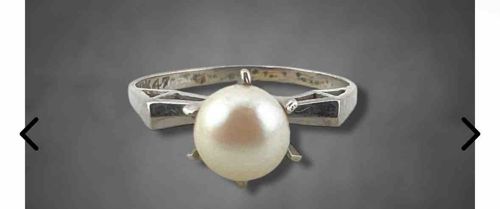
This item is an Art Deco style ring featuring a prominent central pearl set into a silver-toned metal band. The pearl appears to be a cultured pearl, exhibiting a lustrous, creamy white overtone with visible iridescence and reflections across its surface. It is spherical to slightly off-round in shape and of a considerable size, likely between 8-10mm in diameter. The pearl is securely held by a four-prong setting, with two prongs visible at the top and two at the bottom, suggesting a bezel-like security or a basket setting with integrated prongs. The band itself is geometric in design, characteristic of the Art Deco period (roughly 1920s-1930s), with distinct sharp angles and stepped shoulders. The metal, while appearing silver-toned, could be white gold, platinum, or sterling silver, given the context provided in the prompt. There are visible markings, possibly hallmarks or maker's marks, on the interior of the band which are indistinct in the provided image but suggest some level of manufacturing detail. The overall condition appears good, with some superficial scratches consistent with wear visible on the metal, particularly on the outer edges and possibly some signs of patina or light tarnish in crevices, which is expected for an item of its presumed age. The craftsmanship appears solid, with crisp edges on the band and a securely set pearl, indicating a quality piece of jewelry from its era. The design is clean and understated, emphasizing the pearl as the focal point.
AI Appraisal Report
Based on my visual examination of the provided image and the owner's clarification of 'Gold and pearl,' I assess this Art Deco style pearl ring. The central pearl, likely cultured, exhibits good luster and a creamy white overtone, estimated at 8-10mm. The geometric gold band with stepped shoulders is characteristic of the Art Deco period (circa 1920s-1930s). The visible superficial scratches and light tarnish are consistent with age and wear, suggesting good overall condition for its presumed antiquity.
Authenticity of the period design appears strong from the visual cues. The value is influenced by the genuine Art Deco aesthetic, the presence of gold, and a reasonably sized pearl. Market conditions for genuine Art Deco jewelry remain steady, with good demand for wearable, understated pieces like this. Comparables for Art Deco gold rings with cultured pearls of this size typically range from $600 to $1,200, depending on specific metal purity, pearl quality (e.g., natural vs. cultured, overtone, blemish count), and designer provenance.
Key factors impacting value include the actual karat of the gold and the exact type and quality of the pearl. The indistinct internal markings could significantly add to value if they reveal a notable maker. Limitations in authentication from images alone are considerable. A physical examination is crucial to definitively determine the gold's purity (e.g., 10K, 14K, 18K), whether the pearl is natural or cultured (though its appearance strongly suggests cultured), and to precisely assess its quality and any treatments. Magnification would be needed to clarify hallmarks, assess stone setting integrity, and confirm the absence of major repairs or alterations. Provenance documentation, if available, would further enhance authentication and value.