AI estimate as of September 26, 2025 · verify with a professional before acting
AI-Generated · Verify before acting
Everything on this page is generated by AI for informational purposes only. AI can make mistakes — the AI may misidentify items or misattribute them (artist, maker, brand, designer, origin, era). This is not an official valuation and should not be used for insurance, sale, tax, estate, legal, or lending purposes — or any decision requiring a certified appraisal. It is not an authoritative claim about any person, brand, or rights holder — do not share or rely on it as a factual statement about a third party. Always consult qualified professionals before making financial decisions.
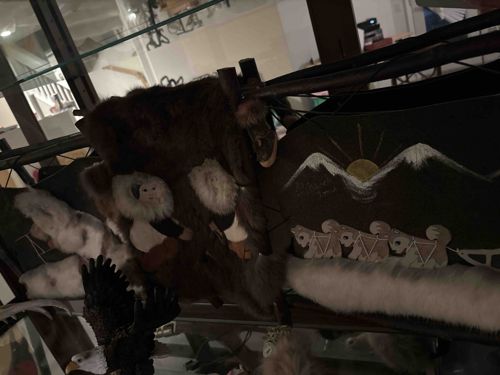
This appears to be a decorative display with strong Inuit or Arctic cultural influences, likely intended for display rather than functional use. The central element is a dark, possibly wooden, sled-like or boat-like structure, upon which various items are arranged. The back panel of this structure is painted with a minimalist landscape featuring white-peaked mountains and a yellow sun with rays, against a dark sky. Below this painted scene, a line of four stylized, light-colored figures resembling traditional sled dogs is carved or applied, each connected by a 'harness' structure, possibly made from string or thread, suggesting a dog sled team. A long strip of white or light-colored fur, possibly rabbit or artificial fur, runs along the base of these figures, simulating snow or ice.
On the left side of the display, a small doll with a light-colored, fur-trimmed hood and dark eyes is visible, along with several pieces of brown and white fur, some appearing to be hide sections. One larger piece of brown fur or hide forms a substantial part of the display's background on the left. Another item resembling a dark, possibly carved, eagle or bird of prey with outstretched wings and a white head is positioned on a lower shelf or in the foreground on the bottom left. The overall construction suggests a handcrafted or folk art quality. The materials, including various furs (real or faux), wood, paint, and possibly textiles for the doll, indicate a rustic and natural aesthetic. The condition suggests some age or gentle handling, with a potential for dust accumulation on the fur elements, but no obvious signs of significant damage or deterioration are discernible from the image. It is likely a souvenir or decorative piece from the mid to late 20th century, celebrating Arctic culture.
AI Appraisal Report
I have examined the provided image of what appears to be an Inuit-inspired decorative sled display. Visually, the piece is in good overall condition for its presumed age, showing typical signs of gentle handling and potential dust accumulation on fur elements, but no obvious structural damage or significant deterioration. Authenticity, based solely on this image, suggests it is a decorative folk art piece rather than an older, traditional cultural artifact. It strongly emulates Inuit art themes and aesthetics, likely produced in the mid-to-late 20th century as a souvenir or decorative item celebrating Arctic culture.
From a market perspective, similar decorative folk art pieces inspired by indigenous cultures, especially those without established artist provenance or significant age, generally fall into a modest value range. Comparables would include other handcrafted tourist art or decorative displays from Arctic regions or inspired by them. Demand for such items is typically driven by their aesthetic appeal and suitability for home decor rather than their historical or artistic significance. Rarity is not a significant factor here; while unique in its specific assembly, the components and style are not uncommon in the broader folk art and souvenir markets.
Key factors impacting value include its decorative appeal, condition, and the perceived craftsmanship. The use of various materials like faux fur, wood, paint, and textile adds to its folk art charm. However, without confirmed provenance linking it to a specific indigenous artist or community, or significant documented age, its value remains in the decorative arts category. For a full authentication, an in-person examination would be required to verify the age and materials (e.g., real vs. faux fur, type of wood), and to check for any maker's marks or inscriptions. Provenance documentation tying it to an artist or a specific region would also significantly enhance its value and authenticity.