AI estimate as of September 6, 2025 · verify with a professional before acting
AI-Generated · Verify before acting
Everything on this page is generated by AI for informational purposes only. AI can make mistakes — the AI may misidentify items or misattribute them (artist, maker, brand, designer, origin, era). This is not an official valuation and should not be used for insurance, sale, tax, estate, legal, or lending purposes — or any decision requiring a certified appraisal. It is not an authoritative claim about any person, brand, or rights holder — do not share or rely on it as a factual statement about a third party. Always consult qualified professionals before making financial decisions.
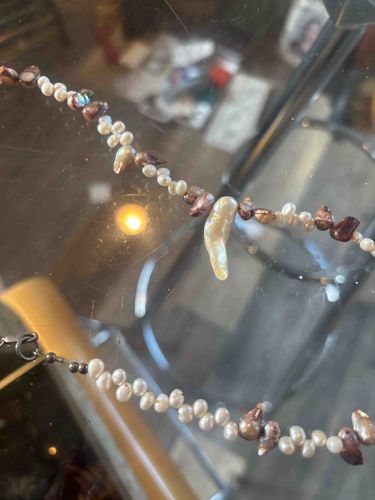
This is a necklace crafted from varying shapes and colors of freshwater pearls, interspersed with larger, elongated Biwa pearls. The necklace features a repeating pattern of small, irregularly shaped white or cream-colored pearls alternating with slightly larger, baroque pearls in shades of brown, bronze, and plum with iridescent overtones. Several prominent, elongated, and highly irregular Biwa pearls, likely natural stick or flame pearls, are situated at intervals creating focal points. These larger pearls exhibit a natural, textured surface and a lustrous, creamy white to light yellow hue. The overall length appears to be a choker or short necklace, judging by the visible portion. The clasp, visible at one end, is a simple silver-toned lobster claw clasp, suggesting a contemporary or modern assembly. The pearls show good luster for freshwater pearls, and while irregular in shape, their natural variations contribute to the organic aesthetic of the piece. There are no visible signs of significant damage, such as nacre loss or chips, though the inherent irregularity of baroque and Biwa pearls means that perfect uniformity is not expected or desired. The craftsmanship appears to be a standard stringing technique, with small crimped beads securing the clasp. The piece has a natural, earthy, yet elegant style, likely dating from the late 20th to early 21st century, consistent with the resurgence of baroque and natural pearl styles.
AI Appraisal Report
Based on my visual examination of the provided image, this Multi-Colored Freshwater Pearl and Biwa Pearl Necklace appears to be in very good condition. The pearls exhibit good luster for freshwater varieties, and there are no discernible signs of significant nacre loss, chips, or damage. The natural irregularities inherent to baroque and Biwa pearls contribute to its organic aesthetic. Authenticity of the pearls as freshwater and Biwa types is strongly suggested by their appearance; however, without in-person examination, precise origin (natural vs. cultured) and specific pearl type (e.g., specific Biwa classifications) cannot be definitively confirmed. This would require direct inspection, and potentially, scientific testing for absolute certainty.
From a market perspective, freshwater pearl jewelry, even with unique Biwa pearls, generally occupies a more accessible price point compared to saltwater pearls due to higher availability. The simple silver-toned lobster claw clasp is functional but not indicative of high-end manufacturing. Demand for natural, earthy, and organic pearl styles has been consistently moderate, ensuring a stable market. Rarity is low for standard freshwater pearls; however, the inclusion of elongated, highly irregular Biwa pearls adds a unique, albeit not exceedingly rare, characteristic.
Factors significantly impacting value include the type and quality of pearls (luster, nacre thickness, size), the craftsmanship of the stringing, and metal components. While the pearls show good visual quality for their type, the basic clasp limits the overall perceived value. An in-person inspection would allow for tactile assessment of nacre quality, strand integrity, and precise identification of pearl types and any treatments. Provenance documentation could also enhance value by confirming origin or historical significance. Given these considerations, and the limitations of image-based appraisal, I estimate the appraisal value of this necklace to be in the range of $150-250.