These notes were written by the person who submitted this item. Appraiser.AI has not verified them, and the AI's identification and estimate may rely on them.
AI Estimated Value
Not an official valuation
$1,800 - $2,500
AI estimate as of July 14, 2025 · verify with a professional before acting
AI-Generated · Verify before acting
Everything on this page is generated by AI for informational purposes only. AI can make mistakes — the AI may misidentify items or misattribute them (artist, maker, brand, designer, origin, era). This is not an official valuation and should not be used for insurance, sale, tax, estate, legal, or lending purposes — or any decision requiring a certified appraisal. It is not an authoritative claim about any person, brand, or rights holder — do not share or rely on it as a factual statement about a third party. Always consult qualified professionals before making financial decisions.
This analysis also relies on unverified notes provided by the user, which may be incomplete or inaccurate and could affect the result.
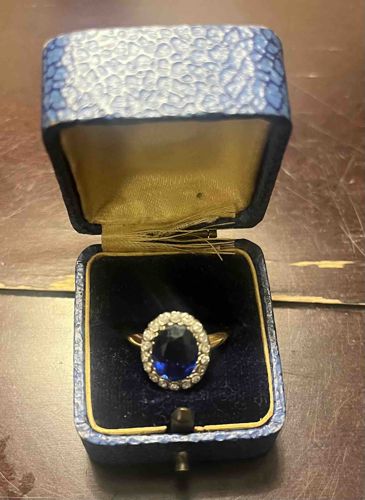
This exquisite piece is an antique or vintage ring featuring a central oval-cut sapphire surrounded by a halo of smaller, round brilliant-cut diamonds. The ring is set in a warm-toned metal, indicated as 14k gold, which suggests a rich, classic aesthetic. The prominent oval sapphire displays a deep, vibrant blue hue, characteristic of fine natural sapphires. The surrounding diamonds, while small, appear to possess good brilliance, adding significant sparkle and contrast to the central gemstone. The setting appears to be a robust bezel or partial bezel for the sapphire, and individual prongs or a shared prong setting for the diamonds, ensuring the security of the stones. The gold band is simple and elegant, tapering slightly towards the ring's head. Given the design, particularly the halo style and the use of gold and natural gemstones, it likely dates to the early to mid-20th century, possibly Edwardian or Art Deco period, or a revival style thereof. Visible condition issues include some wear on the gold setting consistent with age, and the ring box itself shows significant signs of wear and age, with frayed fabric and general deterioration of the exterior material. The craftsmanship appears to be of good quality, with attention paid to the symmetrical arrangement of the stones and the secure setting. No specific maker's marks or signatures are discernible from the provided images.
AI Appraisal Report
Upon examining the provided image and information for this Oval Sapphire and Diamond Halo Ring in 14k gold, I can offer an assessment. The ring exhibits characteristics of early to mid-20th-century design, possibly Art Deco or a later revival. The central oval-cut sapphire displays a good blue hue, and the surrounding brilliant-cut diamonds provide an attractive halo effect, enhancing the sapphire's visual impact. The 14k gold setting, while showing wear consistent with its age, appears structurally sound. The general craftsmanship seems of good quality.
Market conditions for such vintage sapphire and diamond halo rings are generally stable, with consistent demand for well-preserved pieces. Natural sapphires, especially those with good color saturation, maintain their value. The diamonds, while small, contribute to the overall sparkle and precious metal content. The age and aesthetic appeal add to its desirability for collectors and those seeking unique, historically-inspired jewelry. The condition of the ring box, while showing significant wear, further supports the item's vintage nature.
Factors significantly impacting value include the quality and origin of the sapphire (treatment status), the exact carat weight and clarity of the diamonds, and the overall condition of the gold work. Without physical examination, I cannot definitively determine if the sapphire is natural or treated, nor can precise carat weights be established. Authenticity of the gemstones and metal purity (beyond the 14k marking) cannot be fully verified from images alone. An in-person inspection would allow for detailed gemological testing (refractive index, specific gravity, spectroscopy for sapphire origin and treatment), assessment of diamond quality under magnification, and examination for maker's marks or hallmarks. Provenance documentation, if available, would also be invaluable.