AI Appraisal Estimate

AI-generated estimates · not official valuations

From the user

What was submitted

Photo and notes provided by the user — not generated by AI

Submitted item photo
Submitted photo · June 12, 2026

User's notes

No additional notes provided.

AI analysis below

AI appraisal

AI analysis & estimate

AI-Generated · Verify before acting

Everything below is generated by AI for informational purposes only. AI can make mistakes — the AI may misidentify items or misattribute them (artist, maker, brand, designer, origin, era). This is not an official valuation and should not be used for insurance, sale, tax, estate, legal, or lending purposes — or any decision requiring a certified appraisal. It is not an authoritative claim about any person, brand, or rights holder — do not share or rely on it as a factual statement about a third party. Always consult qualified professionals before making financial decisions.

Read the full disclaimer

AI Identification

·Not independently authenticated·Verify before acting

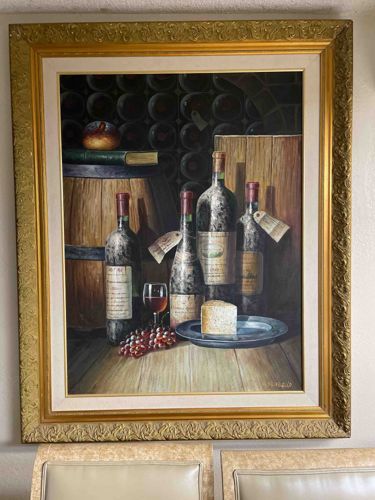
Still Life Painting of a Wine Cellar Composition

Fine Art - Paintings

AI Estimated Value

·Not an official valuation·Verify before acting

$350 - $600

As of June 12, 2026

AI Item Analysis

·AI can make mistakes·Verify before acting
This is a large-format still life oil painting on canvas, likely dating from the mid-to-late 20th century. The composition depicts a rustic wine cellar scene featuring three prominent wine bottles covered in a layer of simulated dust and grime, suggesting aging. The central bottles are flanked by a wooden wine barrel and a crate, with a background consisting of a wine rack filled with horizontal bottles. Small details such as white sales tags, a wedge of cheese on a pewter plate, a glass of red wine, and a cluster of grapes provide textural variety. The color palette is dominated by earthy tones including deep ochre, sienna, and muted greens, with highlights of scarlet on the bottle caps and grapes. The painting is housed in an ornate, gilded wood or composite frame with floral scrollwork and a wide linen-wrapped liner (inner border). There is a visible signature in the lower right-hand corner, though it is difficult to decipher from the image provided. The condition appears fair to good; the canvas shows appropriate tension, though the frame exhibits minor chipping and wear consistent with age. The overall style is reminiscent of the Mediterranean rustic or transitional decor popular in the 1970s through the 1990s.

AI Appraisal Report

·AI can make mistakes·Verify before acting
I have examined the digital representation of this mid-to-late 20th-century still life. The work is a prototypical example of 'commercial fine art' common during the 1970s and 80s, designed for the interior design market rather than the gallery circuit. The execution displays competent handling of trompe-l'oeil techniques, particularly in the dust effects on the bottles and the textural rendering of the grapes and cheese. The condition appears stable; the frame shows expected minor abrasions and chipping to the gilt finish, and the linen liner exhibits slight discoloration consistent with age. Market demand for this specific style—Mediterranean rustic—has softened significantly from its peak in the 1990s, currently finding its primary audience in the decorative secondary market and estate auctions. The value is driven more by the scale and the high-quality ornate framing than by the artist's signature, which appears to be a pseudonym often utilized by commercial art studios of that era. Rare or unique provenance is unlikely given the stylistic hallmarks of mass-market production. Limitations: This evaluation is based solely on digital imagery. A definitive appraisal requires an in-person inspection to verify the canvas substrate, check for overpainting under UV light, and examine the stretcher bars for manufacturer stamps or exhibition labels. Scientific testing of pigment composition would be necessary to confirm a precise date of origin, though it is not warranted by the current market valuation. No formal provenance documentation was provided, which would be essential for elevating the item's status beyond a decorative object.

Get your items appraised

Instant estimates of your treasures with AI-powered appraisals

Browse More Appraisals