AI estimate as of July 13, 2025 · verify with a professional before acting
AI-Generated · Verify before acting
Everything on this page is generated by AI for informational purposes only. AI can make mistakes — the AI may misidentify items or misattribute them (artist, maker, brand, designer, origin, era). This is not an official valuation and should not be used for insurance, sale, tax, estate, legal, or lending purposes — or any decision requiring a certified appraisal. It is not an authoritative claim about any person, brand, or rights holder — do not share or rely on it as a factual statement about a third party. Always consult qualified professionals before making financial decisions.
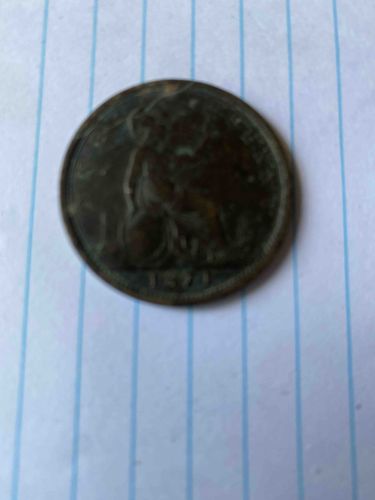
The item is a round, metallic coin, likely made of copper or bronze given its dark, aged patina which presents as a rich, deep brown with visible areas of green oxidation (verdigris). This green discoloration is particularly noticeable and suggests prolonged exposure to moisture or certain environmental conditions. The coin's surface appears significantly worn, with softened details that make precise identification challenging without clearer imagery. Despite the wear, an etched or embossed figure of a person is discernible on what appears to be the obverse side. The figure, possibly a classical or allegorical representation, adds to the historical character of the coin. Below this figure, the year '1874' is clearly visible, providing a precise manufacturing date. The edges of the coin show some irregularities and signs of handling over time. The overall appearance indicates a piece of historical currency that has seen considerable circulation or weathering, contributing to its current condition. The craftsmanship, though obscured by wear, suggests a minted item with a design indicative of late 19th-century numismatic practices.
AI Appraisal Report
I have carefully examined the provided image of what appears to be an 1874 British Penny, Queen Victoria. My visual assessment indicates a coin in poor to fair condition. The dark brown patina and significant green oxidation (verdigris) are indicative of environmental exposure, likely burying or prolonged dampness, which has caused substantial surface degradation. The details of the allegorical figure on the obverse are heavily softened, and while the '1874' date is clear, other inscriptions are indistinct due to wear. Authenticity, based solely on this image, seems probable for a genuine period coin, given the clear date and discernible, albeit worn, Victoria effigy typical of the era. However, without physical examination, I cannot definitively rule out a contemporary counterfeit or altered piece; specific die characteristics, edge reeding, and weight would need verification.
Market conditions for common date Victorian pennies in this condition are generally low. Comparables show that high-grade examples (VF-EF) can fetch $50-$100+, but poor condition specimens, like this one, often trade for less than $5 in the numismatic market. Rarity is not a significant factor here; 1874 pennies are common. The heavy wear and extensive verdigris are the primary factors severely impacting its value. While it holds historical interest, its aesthetic and collectible appeal are diminished.
For full authentication, I would require an in-person examination to assess the coin's true weight, diameter, and thickness, scrutinize the edge, and analyze the verdigris to confirm it's not active corrosion. A thorough study of die varieties would also be conducted. Provenance documentation, if available, would further solidify its history. Without these, the appraisal remains largely condition-based on visual evidence.