AI estimate as of December 13, 2025 · verify with a professional before acting
AI-Generated · Verify before acting
Everything on this page is generated by AI for informational purposes only. AI can make mistakes — the AI may misidentify items or misattribute them (artist, maker, brand, designer, origin, era). This is not an official valuation and should not be used for insurance, sale, tax, estate, legal, or lending purposes — or any decision requiring a certified appraisal. It is not an authoritative claim about any person, brand, or rights holder — do not share or rely on it as a factual statement about a third party. Always consult qualified professionals before making financial decisions.
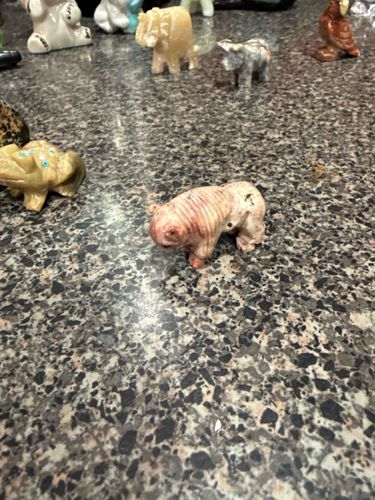
This item is a small, hand-carved stone figurine depicting a bear in a quadrupedal stance, possibly walking or searching. The material appears to be a type of natural stone, likely soapstone or alabaster, given its somewhat translucent quality and the visible striations. The predominant colors are shades of light pink and cream, with distinct darker reddish-brown or burgundy veins and markings that create a natural, organic pattern across the bear's body. These striations are particularly noticeable on the back and sides, adding to the visual texture and uniqueness of the piece. The carving is somewhat abstract or stylized, focusing on the general form of the bear rather than intricate anatomical details. The head features carved, seemingly simple ears and a snout, with no discernible eyes or mouth, contributing to its folk art aesthetic. The legs are sturdy and proportionate, supporting the body. There appears to be a small, dark, irregular mark or inclusion on the upper right side of the bear's back, which could be part of the natural stone’s composition or a minor surface imperfection. The overall finish appears smooth and polished, typical of carved stone figurines. The item's condition appears good, with no obvious chips, cracks, or repairs visible from the provided image. Its size is characteristic of a small desktop or shelf ornament. The craftsmanship suggests a folk art or souvenir quality, indicating it was likely produced as a decorative item. Without specific maker's marks or signatures visible, its exact manufacturing details and age are difficult to ascertain definitively, but it likely dates to the mid-to-late 20th century, a common period for this style of carved stone animal figurines.
AI Appraisal Report
Upon visual examination of the provided image, I assess this hand-carved stone bear figurine to be in good condition. There are no obvious chips, cracks, or repairs visible, and the finish appears smooth and polished. The small dark mark on the upper right side of its back appears to be an inclusion in the natural stone rather than damage. Authenticity, in terms of it being a genuine carved stone item, is evident from the material's visible striations and translucent quality, strongly suggesting soapstone or alabaster. However, without tactile examination, I cannot definitively confirm the specific stone type or rule out very convincing resin reproductions, though the striations lean heavily towards natural stone.
This piece falls into the category of folk art or souvenir carvings. Market conditions for such items are generally modest. Comparables typically include similarly sized and styled animal carvings, often found in gift shops or artisan markets. Demand for these decorative pieces is present but not high, as they are not rare. Factors impacting value here include the natural beauty of the stone's coloration and veining, which is quite appealing. The craftsmanship, while stylized, is competent for its intended folk art aesthetic. The primary limitation in comprehensive appraisal is the inability to physically inspect the item. A hands-on examination would confirm the stone type, assess the true texture and finish, and allow for a more thorough search for any subtle damage or maker's marks not visible in the image. Provenance documentation, if available, could offer insights into its origin or carver, potentially enhancing its value, though this is unlikely for a piece of this nature. Without these, its value remains in the decorative, mass-produced souvenir range.