AI estimate as of August 11, 2025 · verify with a professional before acting
AI-Generated · Verify before acting
Everything on this page is generated by AI for informational purposes only. AI can make mistakes — the AI may misidentify items or misattribute them (artist, maker, brand, designer, origin, era). This is not an official valuation and should not be used for insurance, sale, tax, estate, legal, or lending purposes — or any decision requiring a certified appraisal. It is not an authoritative claim about any person, brand, or rights holder — do not share or rely on it as a factual statement about a third party. Always consult qualified professionals before making financial decisions.
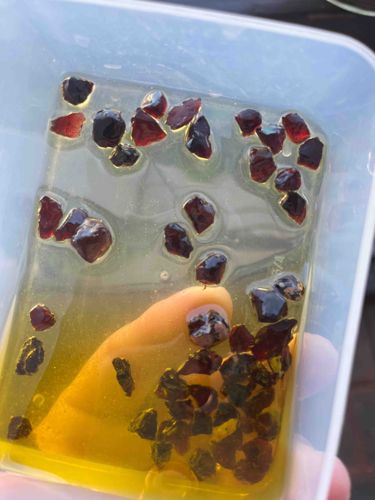
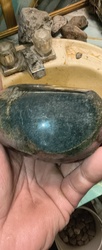
The item consists of a collection of numerous small, irregularly shaped pieces of what appear to be raw, unpolished, and likely un-cut garnet gemstones. These pieces vary in size, with most appearing to be a few millimeters to about a centimeter in their largest dimension. The dominant color is a deep, rich red, characteristic of almandine or pyrope garnets, though some pieces exhibit darker, almost blackish-red hues, possibly due to thick inclusions or very deep color saturation. There are no discernible facets or signs of cutting, indicating they are in their natural, rough state, or possibly crudely broken fragments. The surfaces appear somewhat glassy where light reflects, suggesting a vitreous luster typical of garnets. Some pieces show natural fracture lines and cleavage planes, further confirming their raw state. There are no visible maker's marks, signatures, or specific manufacturing details, as these are natural mineral specimens. The image shows them submerged in a clear, yellowish liquid, possibly water or mineral oil, within a clear plastic container, which seems to serve as a visual aid to examine their translucency and color saturation, as well as to clean or store them. The liquid also highlights their natural internal structures and varying degrees of clarity. A human finger is partially visible in the container, providing a sense of scale. The overall condition appears stable; as natural rough stones, wear and damage are inherent to their formation, and these pieces do not show signs of recent significant external damage like chips from impact. Their estimated age is geological, given their natural mineral origin. The quality is indicated by their vibrant red color and transparency in certain pieces.
AI Appraisal Report
Based on my visual examination of the provided image, these appear to be rough red garnet gemstones, likely almandine or pyrope given their characteristic deep red to darker hues. The pieces vary in size, generally small, and are in their natural, uncut state, displaying typical vitreous luster and natural fracture lines. The condition is stable, consistent with rough mineral specimens. Authenticity of garnet is strongly suggested by the color, luster, and crystal habits visible, though full verification would require physical examination.
Market conditions for rough, small, un-graded garnets are generally on the lower end compared to cut stones or larger, gem-quality rough. Comparables include parcels of rough garnet sold for lapidary rough or tumbling material, often priced by weight. Given the small sizes and un-sorted nature, their primary value lies in their potential use for tumbling, small decorative applications, or very small cabochons, rather than facet-grade material. Demand for such rough material exists among hobbyists, small-scale lapidaries, and collectors of rough minerals, but it is not high-volume or high-value. Rarity is low; garnets are abundant globally.
Factors significantly impacting value include the small individual sizes, irregular shapes, and lack of clarity in many pieces, reducing their potential for faceting. The overall weight, which is not provided, is crucial for a definitive valuation. The yellowish liquid might enhance visibility but doesn't inherently add value.
Limitation in authenticity verification from images alone exist. While consistent with garnet, positive identification requires physical inspection to assess hardness, specific gravity, refractive index, and spectroscopic analysis. In-person examination would allow for tactile assessment, accurate sizing, and weight determination. Provenance documentation would add to confidence, but for common rough minerals, it's rare. Scientific testing, specifically gemological identification tools, would be needed for absolute certainty on species and quality beyond visual cues.