AI estimate as of September 29, 2025 · verify with a professional before acting
AI-Generated · Verify before acting
Everything on this page is generated by AI for informational purposes only. AI can make mistakes — the AI may misidentify items or misattribute them (artist, maker, brand, designer, origin, era). This is not an official valuation and should not be used for insurance, sale, tax, estate, legal, or lending purposes — or any decision requiring a certified appraisal. It is not an authoritative claim about any person, brand, or rights holder — do not share or rely on it as a factual statement about a third party. Always consult qualified professionals before making financial decisions.
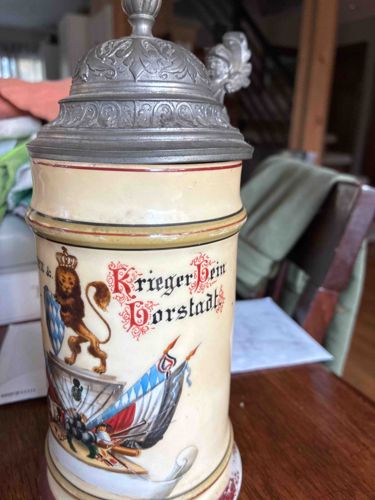
This item is an antique German regimental military beer stein, likely dating from the late 19th to early 20th century. It features a cream-colored ceramic or stoneware body with a cylindrical shape, tapering slightly towards the base and rim. The stein is topped with an elaborate pewter lid, which is hinged and includes an ornate thumb-lift depicting a helmeted figure, possibly a warrior or a knight's head, intricately detailed with flowing decorative elements. The lid itself is heavily embossed with foliate designs and a central finial.
The main body of the stein is adorned with colorful hand-painted decorations. A prominent feature is a rampant lion, crowned and holding a shield with blue and white diamond patterns, indicative of Bavarian heraldry. Below this, a dynamic scene unfolds, showing various military or regimental flags and banners, predominantly in red, white, blue, and black, intertwined or flying amidst what appears to be a ship's bow or a fortress element. Above the pictorial scene, large, decorative Gothic-script lettering, primarily in red, reads 'Krieger dem Vorstadt', which translates to 'Warrior of the Suburb' or 'Warrior to the Suburb'. There are also faint red and black thin lines painted around the top and bottom edges of the main pictorial panel, providing a decorative border. The overall condition appears to be good for its age, though minor surface wear, slight discoloration or patina on the pewter lid, and possible crazing on the ceramic body are typical for such antique pieces and might be present but are not clearly discernible from the provided images. The craftsmanship is evident in the detailed painting and the casting of the pewter lid, suggesting a well-made, commemorative piece.
AI Appraisal Report
Based on my visual examination of the provided image, this antique German regimental military beer stein, likely dating from the late 19th to early 20th century, presents as a charming and well-crafted example of its type. The cream-colored ceramic body with its intricate hand-painted heraldry, military banners, and the Gothic inscription 'Krieger dem Vorstadt' (Warrior of the Suburb) points to a commemorative piece, possibly for a veteran's association or a specific military unit. The prominent crowned rampant lion with the Bavarian lozenge shield strongly suggests a Bavarian origin. The ornate pewter lid, featuring a helmeted figure as a thumb-lift and detailed foliate embossing, further enhances its decorative appeal and collectibility. While the image suggests good overall condition for its age, typical minor issues such as surface wear on the ceramic, slight patina or discoloration on the pewter, or subtle crazing on the glaze are common and cannot be fully assessed without a physical inspection. These factors would generally not significantly detract from its value unless severe.
The market for German regimental steins is generally stable, with prices varying widely based on regiment, rarity, condition, and artistic merit. This stein's detailed painting and elaborate lid are strong value indicators. Comparables for similar elaborate late 19th/early 20th-century regimental steins often fall into the $300-$800 range, with exceptional examples fetching more. The unique inscription and heraldry might appeal to niche collectors, adding to its demand.
Limitations in authenticity verification from images alone are significant. While the style and craftsmanship are consistent with known examples, an in-person examination would be crucial to confirm the material integrity of the ceramic, detect any repairs or restorations, and closely inspect the pewter for hallmarks or manufacturer's marks. Furthermore, tracing any provenance documentation would greatly enhance its authenticity and value. Scientific testing could verify material composition if needed, but is generally less common for these items unless significant doubts arise.