AI Appraisal Estimate

AI-generated estimates · not official valuations

From the user

What was submitted

Photo and notes provided by the user — not generated by AI

Submitted item photo
Submitted photo · June 6, 2026

User's notes

No additional notes provided.

AI analysis below

AI appraisal

AI analysis & estimate

AI-Generated · Verify before acting

Everything below is generated by AI for informational purposes only. AI can make mistakes — the AI may misidentify items or misattribute them (artist, maker, brand, designer, origin, era). This is not an official valuation and should not be used for insurance, sale, tax, estate, legal, or lending purposes — or any decision requiring a certified appraisal. It is not an authoritative claim about any person, brand, or rights holder — do not share or rely on it as a factual statement about a third party. Always consult qualified professionals before making financial decisions.

Read the full disclaimer

AI Identification

·Not independently authenticated·Verify before acting

Vintage Boston Terrier Cast Iron Doorstop

Antique Collectibles and Home Decor

AI Estimated Value

·Not an official valuation·Verify before acting

$150-$250

As of June 6, 2026

AI Item Analysis

·AI can make mistakes·Verify before acting
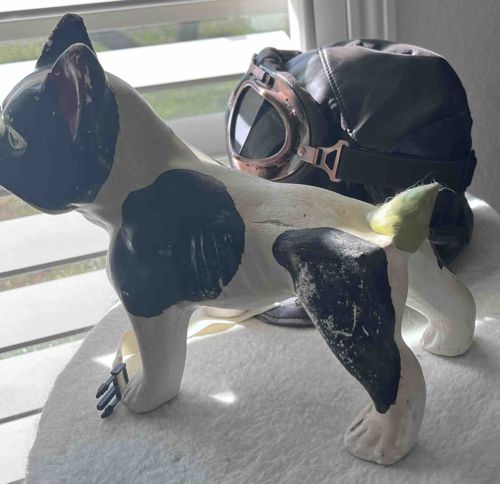
This is a vintage three-dimensional cast iron doorstop depicting a Boston Terrier in a standing 'alert' pose. The item is constructed from heavy cast metal, likely iron, consisting of two molded halves joined together. It features a hand-painted finish with a traditional black and white 'tuxedo' color scheme characteristic of the breed. The piece shows significant signs of age and use; there is extensive paint loss, particularly on the prominent black areas of the back, ears, and hind legs, where the underlying metal is exposed. A notable thick green residue or old repair is visible on the stumpy tail. The surface displays a rough texture and a natural patina consistent with a mid-20th-century decorative piece. The modeling exhibits realistic anatomical details such as the muscular chest, distinct paw shapes, and the breed's signature flat facial structure. While no maker's mark is immediately visible in the image, the style is reminiscent of those produced by manufacturers like Hubley or Bradley & Hubbard during the 1920s to 1940s. The overall condition suggests it was a functional household object rather than a preserved gallery piece.

AI Appraisal Report

·AI can make mistakes·Verify before acting
Upon visual examination of this cast iron Boston Terrier doorstop, I have identified it as a two-piece hollow core casting consistent with early to mid-20th-century American foundry work, likely produced by Hubley or a contemporary competitor. The piece demonstrates authentic characteristics, including visible seams and slotted screw hardware. However, the condition is heavily weathered. The extensive paint loss and significant oxidation on the 'tuxedo' finish detract from the 'originality' premium collectors seek. The green residue on the tail suggests a localized repair or chemical reaction that requires closer inspection to ensure structural integrity. The market for doorstops remains stable, particularly for popular breeds like the Boston Terrier. While a mint-condition Hubley specimen can exceed $600, the significant surface degradation of this piece positions it as a 'decorator' grade item rather than a 'collector' grade investment. Comparables for pieces with similar paint loss typically hammer between $125 and $225 at auction. Critically, a definitive attribution to a specific foundry like Bradley & Hubbard or Hubley is limited by the absence of visible marks and the inability to inspect the interior casting for gate marks or 'sand' texture via photo. A full authentication would require an in-person weight verification (authentic pieces are notably heavy, approx. 4–10 lbs) and a microscopic analysis of the paint layers to confirm they are lead-based period pigments rather than modern restorations. Without provenance or a physical tactile test of the surface 'pitting,' there remains a risk that the piece is a high-quality mid-century reproduction rather than a 1920s original.

Get your items appraised

Instant estimates of your treasures with AI-powered appraisals

Browse More Appraisals