AI estimate as of November 28, 2025 · verify with a professional before acting
AI-Generated · Verify before acting
Everything on this page is generated by AI for informational purposes only. AI can make mistakes — the AI may misidentify items or misattribute them (artist, maker, brand, designer, origin, era). This is not an official valuation and should not be used for insurance, sale, tax, estate, legal, or lending purposes — or any decision requiring a certified appraisal. It is not an authoritative claim about any person, brand, or rights holder — do not share or rely on it as a factual statement about a third party. Always consult qualified professionals before making financial decisions.
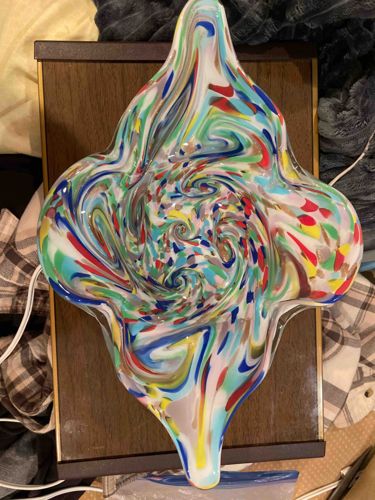
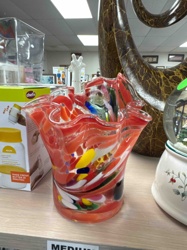
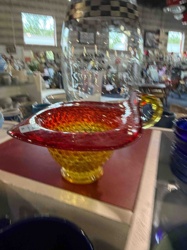
This is a vibrant and irregularly shaped centerpiece bowl crafted from art glass, featuring an explosion of multi-colored swirls and flecks. The primary colors visible include various shades of blue (sky blue, royal blue), green (teal, lime green), red, yellow, and white, with hints of brown and gray, all set against a translucent or opaque white base. The glass itself appears thick and substantial, denoting quality craftsmanship. The form is organic and free-flowing, characterized by an undulating rim and sides that pinch in and out, creating a dynamic, almost star-like or quatrefoil silhouette from an aerial view. The interior of the bowl showcases a prominent spiral motif, where the colors converge and swirl, creating a hypnotic effect. This central swirl suggests a hand-blown or hand-pulled glass technique. There are no visible maker's marks or signatures in the provided images, which is common for art glass pieces. The condition appears excellent with no obvious chips, cracks, or significant wear; the surface reflects light evenly, suggesting a well-maintained, glossy finish. The intricate color application and unique shape point to a decorative art piece, likely from the mid-to-late 20th century or contemporary period, emphasizing aesthetic appeal over strict functionality. The fluidity of the glass and the deliberate color mixing indicate a skilled artisan's work, making it a distinctive conversation piece.
AI Appraisal Report
Upon visual examination of the provided image, this Multi-Colored Swirl Art Glass Centerpiece Bowl presents as a high-quality decorative object. The captivating and irregular form, coupled with the rich, swirling palette of blue, green, red, yellow, and white, speaks to skilled glasswork. The thick glass and glossy finish suggest excellent condition, with no apparent chips, cracks, or significant wear. The organic, free-flowing shape and prominent interior spiral strongly indicate a hand-blown or hand-pulled technique, characteristic of studio art glass. The absence of a visible maker's mark is common for many art glass pieces, which sometimes makes definitive artist attribution challenging without further information.
Market conditions for distinctive, unsigned art glass centerpiece bowls are generally stable. Comparable pieces from known studios or artists can fetch higher prices, but unsigned pieces rely more on aesthetic appeal and craftsmanship. Demand for unique decorative objects remains consistent, but without an artist's name or collection history, rarity is difficult to ascertain solely based on the image. Key factors impacting value include the intricate color application, the substantial material, and the unique, undulating form, which together elevate its decorative appeal.
My assessment of authenticity and condition is based solely on visual cues from the image. While the quality appears high, a physical inspection would be crucial to confirm the absence of subtle flaws, micro-scratches, or repairs not visible in photographs. Furthermore, in-person examination, provenance documentation (e.g., origin of purchase, artist's records), or spectroscopic analysis could potentially identify the artist or studio, significantly impacting its authenticity and value. Without these, the true authenticity of an artist or specific period remains an estimation.