These notes were written by the person who submitted this item. Appraiser.AI has not verified them, and the AI's identification and estimate may rely on them.
AI Estimated Value
Not an official valuation
$3,500 - $5,500
AI estimate as of December 15, 2025 · verify with a professional before acting
AI-Generated · Verify before acting
Everything on this page is generated by AI for informational purposes only. AI can make mistakes — the AI may misidentify items or misattribute them (artist, maker, brand, designer, origin, era). This is not an official valuation and should not be used for insurance, sale, tax, estate, legal, or lending purposes — or any decision requiring a certified appraisal. It is not an authoritative claim about any person, brand, or rights holder — do not share or rely on it as a factual statement about a third party. Always consult qualified professionals before making financial decisions.
This analysis also relies on unverified notes provided by the user, which may be incomplete or inaccurate and could affect the result.
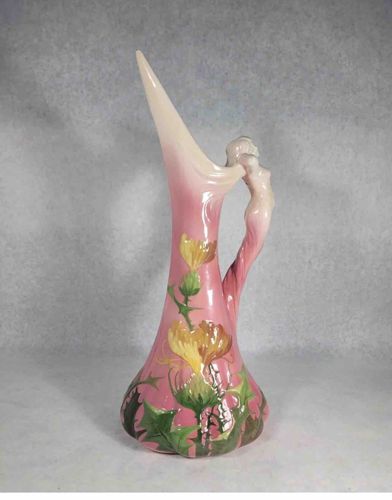
This is a vibrantly colored French Majolica vase, likely produced by Delphin Massier, renowned for his ceramic work in Vallauris. The vase features a distinctive amphora-like form with a tall, elongated, pointed spout that transitions from a pale cream to a rich, glossy pink at the body. The body itself is a deep rose pink, decorated with highly detailed and relief-molded thistles in hues of olive green for the prickly leaves and stems, and striking yellow-orange for the thistle blooms. The base of the vase also incorporates the thistle motifs, creating a sense of organic growth. A unique and prominent feature is the handle, sculpted in the form of a kneeling or crouching nymph, whose body is depicted in a pale, almost flesh-toned ceramic, and appears to merge into the overall pink coloration of the vase body. Her delicate features and form are visible. The glazing is a high-gloss finish, characteristic of Majolica, which enhances the rich colors and three-dimensional qualities of the relief work. The visible condition appears good, with no obvious chips, cracks, or significant losses to the glaze, though a thorough inspection would be needed to confirm this. The craftsmanship is indicative of the Art Nouveau period, roughly late 19th to early 20th century, where naturalistic forms and decorative elements were highly prized. The combination of the vivid color palette, the intricate botanical motifs, and the figural handle makes this a highly decorative and collectible piece.
AI Appraisal Report
Based on my visual examination of the provided image and the owner's details, this Delphin Massier Majolica Thistle Vase with Nymph Handle presents as a superb example of French Art Nouveau ceramics. The vibrant, high-gloss Majolica glaze, characteristic of Massier's work from Vallauris, is stunning. The relief-molded thistles with their olive green leaves and striking yellow-orange blooms against the deep rose-pink body demonstrate exceptional craftsmanship. The figural nymph handle, beautifully sculpted and integrated into the vase's form, is a truly distinctive feature that elevates its rarity and appeal.
From the image, the condition appears excellent, with no immediately visible chips, cracks, or significant glaze losses. However, a physical inspection would be crucial to confirm this, as minor professional repairs or hairline cracks can be very difficult to detect through photographs. Authenticity, while strongly suggested by the style, quality, and the owner's attribution, cannot be definitively confirmed without examining the base for artist's marks, stamps, or signatures. Provenance documentation, such as original sales receipts or exhibition records, would also significantly aid in authentication.
Market conditions for high-quality Art Nouveau decorative arts remain strong, especially for pieces by recognized makers like Delphin Massier. The combination of its impressive size, intricate botanical detail, vivid color palette, and the unique figural element ensures high demand among collectors. Comparable Delphin Massier figural or large, ornate vases typically fetch prices in this range, particularly those with such complex modeling and vibrant glazing. Rarer forms or exceptionally well-preserved examples can exceed this estimate. The primary factors influencing value are the confirmed authenticity (through marks or provenance) and the impeccable, verified physical condition, particularly the absence of restorations. Without in-person inspection and mark verification, I must note that this appraisal is based solely on visual evidence and reported maker attribution.