AI estimate as of September 5, 2025 · verify with a professional before acting
AI-Generated · Verify before acting
Everything on this page is generated by AI for informational purposes only. AI can make mistakes — the AI may misidentify items or misattribute them (artist, maker, brand, designer, origin, era). This is not an official valuation and should not be used for insurance, sale, tax, estate, legal, or lending purposes — or any decision requiring a certified appraisal. It is not an authoritative claim about any person, brand, or rights holder — do not share or rely on it as a factual statement about a third party. Always consult qualified professionals before making financial decisions.
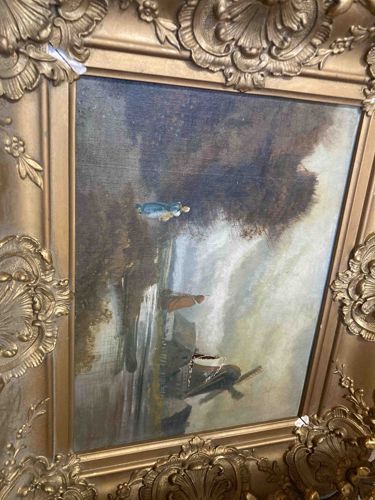
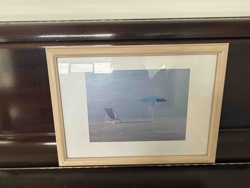
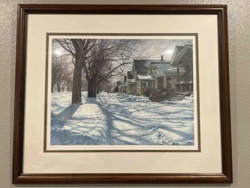
This appears to be an antique or vintage oil painting depicting a rustic countryside landscape, likely European in origin, housed within an ornate gilded frame. The painting itself showcases a muted color palette, dominated by earthy tones, greys, and blues. Visible elements include what appears to be a windmill or watermill structure to the lower right, with some figures or boats nearby, suggesting human activity within the scene. A waterfall or cascading water feature is prominent in the mid-ground, leading the eye downwards. The background is characterized by dark, possibly stormy or shadowy, volumetric clouds or trees. The brushstrokes seem to be relatively loose and expressive, indicative of a landscape painting style from perhaps the 19th or early 20th century.
The frame is a significant feature, crafted from wood and heavily adorned with elaborate carved or molded gesso ornamentation. The gilding, while largely intact, shows areas of wear, revealing a darker underlayer, indicating age and handling. There are chips and losses to the gesso ornamentation, particularly noticeable in the upper left corner where a piece of the decorative scrollwork has broken off. The overall construction of the frame suggests quality craftsmanship typical of the period it emulates, likely Rococo Revival or Baroque inspired. The condition of the painting itself is difficult to ascertain fully from the image, but it appears to have some surface grime or discoloration consistent with age, and potentially some craquelure, though no major tears or punctures are immediately evident. The rich patina of both the painting and the frame adds to its antique appeal.
AI Appraisal Report
Based on my visual assessment of the provided image, this oil painting, depicting a countryside landscape with a windmill/watermill, figures, and a waterfall, appears to be a charming decorative piece, likely European and dating from the late 19th to early 20th century. The loose, expressive brushwork and muted palette are indicative of landscape styles popular during that period. The painting's condition shows age-consistent surface grime and potential craquelure, which are expected and contribute to its antique character. No major tears or punctures are evident, which is a positive.
The ornate gilded frame, while visually impressive, exhibits significant wear including chips and losses to the gesso ornamentation, particularly in the upper left corner. While typical of the period, these losses do detract slightly from the overall presentation.
From an appraisal perspective, this piece falls into the decorative antique art category. Demand for such landscapes is steady, but not exceptionally high unless attributed to a specific, recognized artist. Without a signature or clear artist attribution, its value is primarily driven by its aesthetic appeal, size, and condition as a decorative object.
Limitations in authenticity verification from images alone are significant. I cannot confirm the medium definitively (though it appears to be oil), nor can I inspect for underlying damage, repairs, or determine the exact age or artist. A full in-person examination would allow for solvent testing, UV light examination for prior restorations, and a direct assessment of surface condition. Provenance documentation (such as previous ownership or exhibition history) would be crucial for attributing the work to a specific artist or school, which would dramatically impact its value. Scientific analysis, like pigment analysis, could confirm dating. Comparable sales for similar unsigned, decorative landscape oils from this period typically range from a few hundred to just over a thousand dollars, depending on quality and size.