These notes were written by the person who submitted this item. Appraiser.AI has not verified them, and the AI's identification and estimate may rely on them.
AI Estimated Value
Not an official valuation
$250 - $400
AI estimate as of November 30, 2025 · verify with a professional before acting
AI-Generated · Verify before acting
Everything on this page is generated by AI for informational purposes only. AI can make mistakes — the AI may misidentify items or misattribute them (artist, maker, brand, designer, origin, era). This is not an official valuation and should not be used for insurance, sale, tax, estate, legal, or lending purposes — or any decision requiring a certified appraisal. It is not an authoritative claim about any person, brand, or rights holder — do not share or rely on it as a factual statement about a third party. Always consult qualified professionals before making financial decisions.
This analysis also relies on unverified notes provided by the user, which may be incomplete or inaccurate and could affect the result.
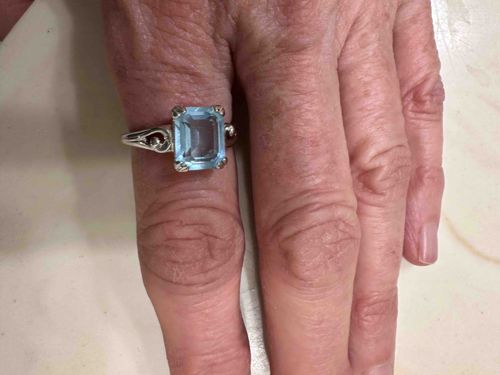
The item is a ladies' ring featuring a prominent aquamarine gemstone set in a silver-toned metal, likely sterling silver given the visual characteristics. The central gemstone is an emerald-cut aquamarine, exhibiting a clear, light blue hue with high transparency and significant brilliance, suggesting good quality. Its rectangular shape with cut corners, characteristic of an emerald cut, measures approximately 10-12mm in length and 7-9mm in width. The stone is secured by four prongs, one at each corner, composed of the same silver-toned metal as the band. The ring's band is slender, featuring an openwork or filigree design on the shoulders leading up to the gemstone setting. This decorative element appears to have a stylized scroll or heart motif on each side, adding an elegant, possibly vintage, touch. The metal components show a polished finish with some visible surface wear consistent with regular use, but no significant damage like deep scratches, dents, or repairs are immediately apparent. The overall construction appears solid and well-crafted. Given the style of the setting and the decorative shoulders, the ring likely dates from the mid-20th century to a more contemporary period, possibly inspired by Art Deco or vintage aesthetics. No visible maker's marks or stamps are discernable from the image. The aquamarine appears well-seated within its prongs, and no chips or fractures are visible on the stone.
AI Appraisal Report
Based on my visual examination of the provided image, this is a ladies' ring featuring an emerald-cut aquamarine gemstone set in what appears to be sterling silver. The aquamarine, measuring approximately 10-12mm by 7-9mm, exhibits a clear, light blue hue and good transparency, suggesting a decent quality stone. Its four-prong setting is secure, and the stone itself shows no visible chips or fractures. The slender band features an attractive openwork or filigree design on the shoulders, possibly a stylized scroll or heart motif, which adds a vintage aesthetic. The metal has a polished finish and displays some light surface wear consistent with regular use, but no significant damage or repairs are apparent. The overall construction strikes me as solid and well-made.
Market conditions for sterling silver aquamarine rings are generally stable. While aquamarine is a popular gemstone, sterling silver pieces typically fall into a more accessible price range compared to gold or platinum. Comparable rings with similar stone sizes and silver settings, especially those with decorative detailing, often retail in the $200-$500 range, depending on the exact quality of the aquamarine and the craftsmanship. The demand for vintage-inspired or Art Deco style jewelry remains consistent, supporting its value. Factors impacting this value include the potential for specific maker's marks, which are not visible here, and the exact purity of the silver.
It is crucial to note the limitations of an appraisal based solely on an image. While the stone's appearance is promising, detailed verification of authenticity and quality, including exact carat weight, clarity grade, and treatment status, would require in-person examination by a gemologist. Furthermore, confirming the metal composition as sterling silver would necessitate testing, as well as a thorough search for hallmarks. Without these, the authenticity verification remains visual and therefore limited. An in-person inspection could also reveal any hidden damage or repairs that are not visible in the photograph.