AI estimate as of August 26, 2025 · verify with a professional before acting
AI-Generated · Verify before acting
Everything on this page is generated by AI for informational purposes only. AI can make mistakes — the AI may misidentify items or misattribute them (artist, maker, brand, designer, origin, era). This is not an official valuation and should not be used for insurance, sale, tax, estate, legal, or lending purposes — or any decision requiring a certified appraisal. It is not an authoritative claim about any person, brand, or rights holder — do not share or rely on it as a factual statement about a third party. Always consult qualified professionals before making financial decisions.
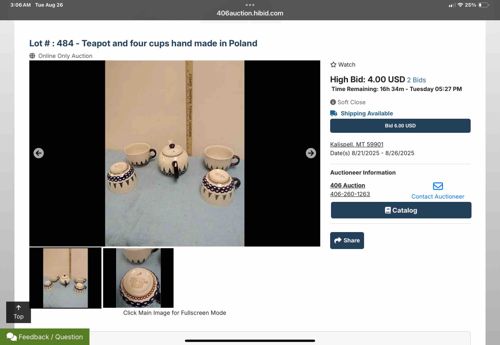
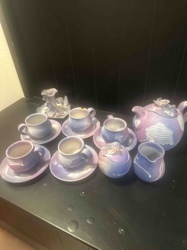
This is a five-piece ceramic tea set, described as 'hand-made in Poland,' consisting of one teapot and four matching cups. The pieces exhibit a cream or off-white base color adorned with a distinctive dark blue, possibly cobalt, decorative pattern. The teapot is globular with a small spout and handle, featuring the blue design predominantly around its lower body and lid, likely encompassing abstract floral or geometric motifs consistent with traditional Polish pottery, particularly Bolesławiec ceramics. The four cups, two of which are clearly visible as standard mugs with handles, and two appear to be lid-covered vessels or perhaps additional cups, are decorated with the same blue pattern. The patterned design on the cups and the covered vessels appears to be a band around the exterior, possibly with circular or dotted elements, giving it a somewhat rustic yet elegant appeal. The overall condition appears to be good, with no overt chips, cracks, or significant wear visible from the provided images, though a closer inspection would be required to confirm this. The craftsmanship seems solid, indicating stoneware or earthenware construction, likely hand-painted, which contributes to its unique character. The presence of lids on two of the cups suggests they might be lidded mugs, individual sugar/creamer pots, or possibly small serving dishes, adding to the set's versatility. The style strongly points to a folk art or traditional Polish design, suggesting it is a contemporary or vintage piece rather than an antique. The visible markings appear to be part of the decorative scheme, with no distinct maker's marks or signatures discernible from the image, but the 'hand-made in Poland' attribution is a significant indicator of its origin and potential quality.
AI Appraisal Report
Upon visual examination of the provided image, this five-piece ceramic tea set, described as 'hand-made in Poland,' presents in good overall condition. The cream/off-white base with the distinctive dark blue (likely cobalt) pattern is consistent with traditional Polish pottery, specifically Bolesławiec ceramics. No overt chips, cracks, or significant wear are discernible, suggesting careful handling. The craftsmanship appears solid, indicative of stoneware or earthenware construction, likely hand-painted, which enhances its unique character.
From the image alone, authenticity cannot be definitively verified beyond the 'hand-made in Poland' attribution. To fully authenticate, an in-person examination would be crucial to inspect for maker's marks, compare patterns to known Polish producers, and assess the clay body and glaze quality. Provenance documentation (purchase receipts, certificates of authenticity) and potentially scientific testing (e.g., elemental analysis of glazes) would further confirm its origin and period.
Market conditions for hand-made Polish ceramics are generally stable, with a consistent demand for unique, high-quality pieces. Comparables typically range based on size, complexity of design, and maker. While not rare, the 'hand-made' aspect and traditional design contribute to its value. Factors impacting value include the number of pieces, the intact condition, and the appealing aesthetic. The versatility implied by the 'lidded cups' (which could be sugar/creamer pots) adds to its functionality and appeal.
My assessment is limited by the lack of physical inspection, which would allow for tactile evaluation, detailed examination of all surfaces, and identification of any subtle imperfections or marks not visible in the image. However, based on the visual information, it appears to be a desirable set for collectors of Polish pottery or those seeking quality handcrafted items.