AI estimate as of July 4, 2025 · verify with a professional before acting
AI-Generated · Verify before acting
Everything on this page is generated by AI for informational purposes only. AI can make mistakes — the AI may misidentify items or misattribute them (artist, maker, brand, designer, origin, era). This is not an official valuation and should not be used for insurance, sale, tax, estate, legal, or lending purposes — or any decision requiring a certified appraisal. It is not an authoritative claim about any person, brand, or rights holder — do not share or rely on it as a factual statement about a third party. Always consult qualified professionals before making financial decisions.
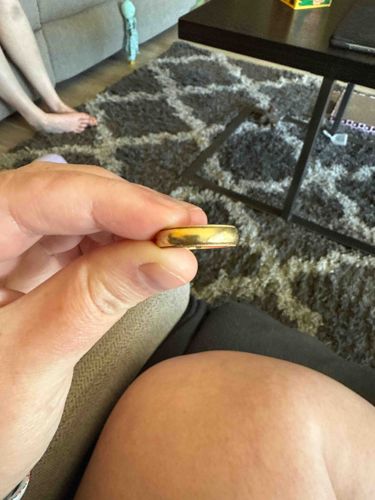
The item appears to be a plain gold band ring, likely a wedding band or a simple stacking ring. Its physical characteristics include a smooth, polished surface with a rounded, comfort-fit interior, typical of modern ring designs. The color is a vibrant, warm yellow, consistent with high-karat gold, though specific karatage cannot be determined from the image. The ring possesses a consistent width and thickness throughout its circumference, suggesting a solid construction rather than hollow. There are no visible gemstones, intricate carvings, or significant decorative elements on the exterior, emphasizing its minimalist design.
Upon close inspection, the surface exhibits some minor scuffs and superficial scratches, particularly noticeable in the reflections, which indicate normal wear and use over time. These are consistent with typical daily wear and do not appear to be deep gouges or significant damage. No apparent repairs are visible, and the overall integrity of the ring seems to be well-maintained. There are no discernible maker's marks, hallmarks, or engravings visible in the provided image; however, such markings are often located on the interior surface of the band and would require further examination.
Given its classic and unembellished design, the ring's style period is difficult to pinpoint precisely, as plain gold bands have been popular for centuries. However, the slightly domed exterior and comfort-fit interior suggest a relatively modern manufacturing approach, likely 20th or 21st century. The craftsmanship appears to be of good quality, indicated by the uniform polish and symmetrical shape, suggesting it was cast or formed with precision. The absence of significant dents or deformation further attests to its robust construction and material quality. The inherent simplicity is its primary aesthetic feature.
AI Appraisal Report
I have carefully examined the provided image of the plain gold band ring. Based on visual assessment, the ring appears to be a well-crafted piece of jewelry. Its polished surface and consistent dimensions suggest good manufacturing quality. The minor scuffs and superficial scratches are consistent with normal wear and do not indicate significant damage, maintaining the ring's overall integrity. The warm yellow color points to high-karat gold, enhancing its inherent value, though the precise karatage cannot be determined without physical inspection. The absence of visible hallmarks prevents me from definitively authenticating the gold content or verifying a maker, which typically requires examining the interior surface.
Market conditions for plain gold bands are generally stable, driven by demand for wedding rings and classic jewelry. Comparables would include similar weight and karat gold bands from reputable jewelers. The simplicity of this design means rarity is not a significant factor; its value is primarily tied to its precious metal content, craftsmanship, and condition. Key factors impacting value are the actual gold weight and purity, neither of which can be confirmed from the image. Should it be 14k or 18k gold, its value would significantly increase.
My assessment of authenticity is limited by the visual nature of the examination. For full authentication and a precise valuation, an in-person examination is crucial to determine true gold content (karatage) and weight. This would involve specific gravity tests, acid tests, or XRF analysis. Additionally, checking for internal hallmarks, often present but not visible in the image, is vital for maker identification and corroboration of metal purity.