AI estimate as of August 17, 2025 · verify with a professional before acting
AI-Generated · Verify before acting
Everything on this page is generated by AI for informational purposes only. AI can make mistakes — the AI may misidentify items or misattribute them (artist, maker, brand, designer, origin, era). This is not an official valuation and should not be used for insurance, sale, tax, estate, legal, or lending purposes — or any decision requiring a certified appraisal. It is not an authoritative claim about any person, brand, or rights holder — do not share or rely on it as a factual statement about a third party. Always consult qualified professionals before making financial decisions.
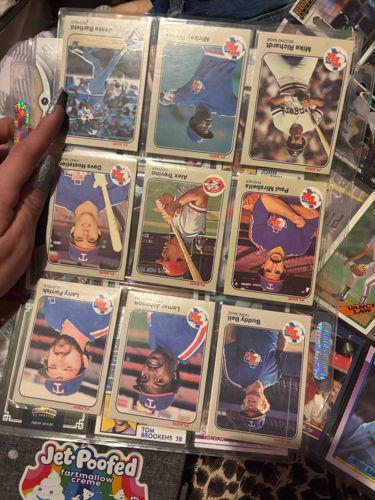
The item is a collection of baseball trading cards, likely from the 1980s, housed within a clear plastic nine-pocket binder page. Each card features a professional baseball player, with their name prominently displayed at the top. The cards appear to be from Fleer, indicated by the 'FLEER' logo or a similar brand identifier on at least one visible card. The cards exhibit a consistent design featuring a white border, a color photograph of the player, and a team logo or insignia, such as the 'T' for the Texas Rangers, visible on multiple cards. The reverse side of the cards is not visible. Visible players include Jesse Barfield, Mickey (likely Mickey Hatcher or Tettleton), Mike Richardt, Dave Hostetler, Alex Trevino, Paul Mirabella, Larry Parrish, Lamar Johnson, and Buddy Bell. The overall condition of the cards appears good, with no obvious major creases, tears, or significant discoloration. They are well-protected within the plastic sleeves, which helps preserve their condition. Some cards might exhibit minor corner wear consistent with their age and handling, but this is not clearly discernible from the image. The glossy finish of the cards is still apparent, suggesting minimal abrasion. The plastic page itself shows some minor scuffs or dust, but is functional. The cards are uniform in size, typical of standard baseball cards (approximately 2.5 x 3.5 inches). The style period is clearly indicative of late 20th-century baseball card production, with the photography and card design reflective of the era.
AI Appraisal Report
I have examined the provided image of this collection of 1980s Fleer Baseball Trading Cards. The cards appear to be in good overall condition, protected within their clear plastic sleeves. There are no obvious major creases, tears, or significant discoloration visible, and the glossy finish appears intact. This suggests a condition consistent with 'Near Mint' to 'Excellent' for many, though minor corner wear is possible and cannot be fully assessed from a digital image.
Authenticity, based purely on visual inspection, is high; these appear to be genuine Fleer cards from the 1980s given their consistent design, visible 'FLEER' logo, and listed players from that era. However, without physical examination, I cannot rule out sophisticated counterfeits, though these are less common for common 1980s cards. Full authentication would require in-person inspection to verify card stock, print quality, and UV light testing.
From a market perspective, these are common players from the 1980s Fleer sets, which were widely produced. While nostalgic, individual values for these specific players are typically low (often under $1 per card). The overall demand for common 1980s Fleer cards is modest. Rarity is not a factor here, as these are mass-produced cards. The value is primarily driven by the collective appeal to a casual collector or for set building. There are no obvious star players or significant rookie cards visible that would dramatically increase this value.
Limitations: My assessment of condition is based solely on the image; physical handling would be necessary to confirm surface imperfections, corner sharpness, and centering. The exact year of the Fleer set is not fully discernible, which can slightly impact value, but the players listed place it firmly within the 1980s. Without seeing the reverse of the cards, completeness of information or print errors cannot be checked.