These notes were written by the person who submitted this item. Appraiser.AI has not verified them, and the AI's identification and estimate may rely on them.
AI Estimated Value
Not an official valuation
$1,800 - $2,500
AI estimate as of September 16, 2025 · verify with a professional before acting
AI-Generated · Verify before acting
Everything on this page is generated by AI for informational purposes only. AI can make mistakes — the AI may misidentify items or misattribute them (artist, maker, brand, designer, origin, era). This is not an official valuation and should not be used for insurance, sale, tax, estate, legal, or lending purposes — or any decision requiring a certified appraisal. It is not an authoritative claim about any person, brand, or rights holder — do not share or rely on it as a factual statement about a third party. Always consult qualified professionals before making financial decisions.
This analysis also relies on unverified notes provided by the user, which may be incomplete or inaccurate and could affect the result.
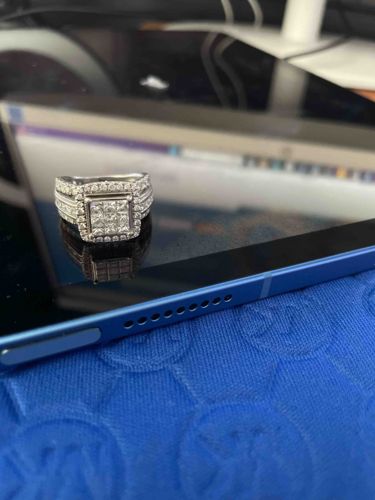
This is a contemporary diamond cluster ring, likely crafted from white gold or platinum, given its bright, silvery-white metallic appearance that reflects light vividly. The ring's design features a prominent square-shaped cluster of diamonds at its center, creating the illusion of a larger, single princess-cut diamond. This central 'invisible set' or close-set cluster consists of multiple smaller, brilliant-cut diamonds, precisely arranged to minimize gaps and maximize sparkle. Surrounding this central cluster is a halo of additional smaller, round brilliant-cut diamonds, enhancing its visual size and brilliance. The shoulders of the ring band are also adorned with multiple rows of pavé-set or channel-set round brilliant-cut diamonds, extending several rows down each side and contributing to a luxurious, wide profile. The overall construction appears solid and well-finished, with a polished metal surface. The diamonds exhibit good clarity and color based on their sparkle and apparent whiteness, although precise grading would require close inspection. No visible major damage, such as missing stones, significant scratches, or deformities, is apparent from the image. The setting style and abundance of diamonds suggest a modern, possibly bridal or fashion jewelry piece. Without maker's marks or specific hallmarks visible, precise manufacturing details are speculative, but the craftsmanship appears to be of standard to good quality for mass-produced fine jewelry. The estimated age is late 20th to 21st century. The ring has a substantial presence, indicating it is designed to be a prominent adornment.
AI Appraisal Report
Based on my visual examination of the provided image of Kay's diamond cluster ring, I assess its condition as excellent, with no visible damage, missing stones, or significant wear. The design features a prominent square-shaped diamond cluster at the center, creating the aesthetic of a large princess-cut diamond, surrounded by a halo of smaller round brilliant-cut diamonds. The shoulders are also adorned with multiple rows of pavé-set diamonds, indicating a high diamond count. This styling points to a contemporary piece, likely late 20th or 21st century, crafted from white gold or platinum, given its bright, reflective luster. The diamonds appear clear and bright, exhibiting good sparkle, consistent with standard commercial quality for color and clarity (likely G-I color, VS2-SI2 clarity range, although this is an estimate).
In terms of market conditions, diamond cluster rings, especially those with significant diamond coverage, are consistently in demand for both bridal and fashion jewelry. Comparables for such an intricate design with this apparent diamond weight (estimated total carat weight could be 1.5-2.5 carats, though this is speculative) would typically retail in the $2,500 - $4,000 range when new, depending on the exact specifications of the diamonds and metal. As a secondary market item, a conservative appraisal value is appropriate. The demand for well-maintained, visually impressive diamond rings remains stable.
Factors significantly impacting value include the substantial diamond coverage, the intricate cluster and halo design, and the apparent good condition. The main limitation in this appraisal is the lack of a physical examination. I cannot definitively confirm the metal type (white gold vs. platinum), precise diamond carat weight, cut quality, color, or clarity, which are critical for an exact valuation. I also cannot verify the presence of hallmarks or maker's marks, which would aid in authenticating the manufacturer and material. For full authentication and a more precise valuation, an in-person examination by a gemologist would be essential to weigh the item, test the metal, and grade the diamonds accurately.