AI estimate as of December 5, 2025 · verify with a professional before acting
AI-Generated · Verify before acting
Everything on this page is generated by AI for informational purposes only. AI can make mistakes — the AI may misidentify items or misattribute them (artist, maker, brand, designer, origin, era). This is not an official valuation and should not be used for insurance, sale, tax, estate, legal, or lending purposes — or any decision requiring a certified appraisal. It is not an authoritative claim about any person, brand, or rights holder — do not share or rely on it as a factual statement about a third party. Always consult qualified professionals before making financial decisions.
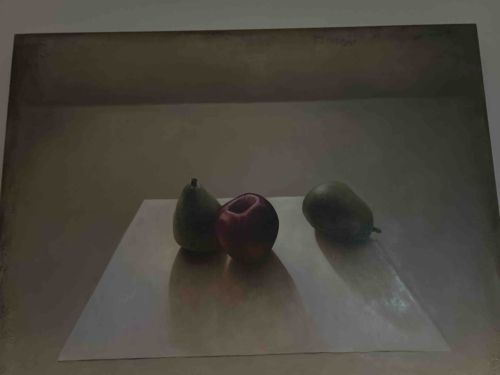
This item is a still life painting, likely executed in oil on canvas or board, depicting two pears and one apple arranged on a reflective, light-colored surface within a minimalist, dimly lit setting. The overall color palette is subdued, dominated by muted browns, grays, and the natural tones of the fruit. The left pear appears olive green, the central apple is a deep reddish-burgundy, and the right pear is a darker, desaturated green or brownish-green. The fruit cast prominent shadows on the surface, indicating a light source from the upper left. The background is a solid, warm gray or tan, creating a shallow box-like space that emphasizes the subjects. The reflective surface beneath the fruit shows subtle highlights and reflections, suggesting a polished or treated material. While no discernible artist's signature or specific markings are visible in the provided image, the style appears to be a contemporary take on traditional still life, possibly created in the late 20th or early 21st century. The craftsmanship is evident in the careful rendering of light and shadow, the volumetric representation of the fruit, and the creation of atmospheric depth despite the simple composition. There are no obvious signs of significant damage such as tears, punctures, or extensive paint loss, though the overall lighting of the photograph makes a detailed assessment of condition difficult. The edges of the canvas/board visible at the top and left show some minor wear consistent with handling or framing.
AI Appraisal Report
I have examined the image of this still life painting depicting two pears and an apple. Visually, the condition appears good, with no obvious signs of major damage such as tears or significant paint loss. There is minor wear around the edges, consistent with handling. Authenticity, based solely on this image, cannot be definitively determined. While the style suggests a contemporary take on traditional still life, possibly late 20th or early 21st century, the artist remains unknown. Without a visible signature or provenance, verifying the artist's identity and authenticity is impossible from a photograph alone.
Market conditions for unsigned contemporary still life paintings by unknown artists are generally modest. While the craftsmanship is apparent in the rendering of light, shadow, and volume, the lack of an identifiable artist significantly impacts its value. Comparables would include decorative art pieces or works by emerging, unrepresented artists. Demand for such pieces exists within the general art market for home decor or entry-level collectors, but rarity is not a factor given the unknown origin. The atmospheric depth and careful composition are positive attributes; however, the absence of artist identification, exhibition history, or documented provenance limits its potential significantly.
For full authentication and a more precise valuation, an in-person examination would be crucial to assess paint quality, substrate, and potential hidden signatures. Provenance documentation, such as purchase receipts or ownership history, is essential. Additionally, scientific testing, like pigment analysis, could offer insights into the period of creation, though this is typically reserved for higher-value works. As it stands, without these elements, the value remains in the decorative art market range.