AI estimate as of September 7, 2025 · verify with a professional before acting
AI-Generated · Verify before acting
Everything on this page is generated by AI for informational purposes only. AI can make mistakes — the AI may misidentify items or misattribute them (artist, maker, brand, designer, origin, era). This is not an official valuation and should not be used for insurance, sale, tax, estate, legal, or lending purposes — or any decision requiring a certified appraisal. It is not an authoritative claim about any person, brand, or rights holder — do not share or rely on it as a factual statement about a third party. Always consult qualified professionals before making financial decisions.
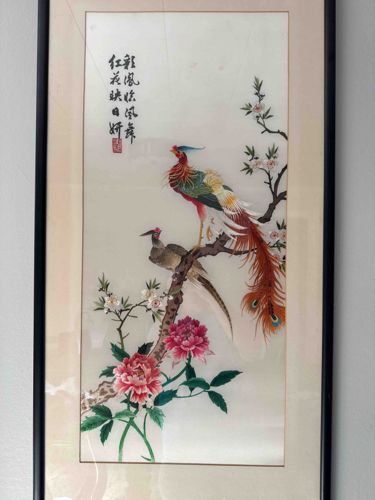
This is a rectangular, vertically oriented framed artwork featuring an intricate Chinese silk embroidery. The embroidery depicts two pheasants, one male and one female, perched on a blossoming branch with large pink peonies and smaller white cherry blossoms. The male pheasant, positioned higher, is vibrantly colored with iridescent blues, greens, reds, and oranges, showcasing a long, flowing tail with distinct 'eyes' typical of peacock or pheasant feathers. The female pheasant below is more subdued in coloring, primarily shades of brown and beige. The embroidery demonstrates exceptional craftsmanship, likely employing various stitching techniques to create texture and depth in the feathers, petals, and leaves. The background appears to be a light, possibly silk or linen fabric. In the upper left corner, there are Chinese characters, likely a poem or dedication, written in black ink, accompanied by a red seal signature, indicative of the artist or calligrapher. The artwork is housed within a dark, possibly black, wooden frame with a lighter, creamy inner matting or lining that highlights the embroidery. The work is protected by glass. Visible condition appears good, with no obvious signs of tearing, significant discoloration, or damage to the embroidery itself, though the frame shows some general wear consistent with age. This style of detailed bird and flower embroidery is characteristic of traditional Chinese silk art and suggests an approximate age from the mid to late 20th century, or possibly earlier given the intricate detail, possibly from the Suzhou embroidery school renowned for such artistry. The quality of the stitching and vibrant, realistic depiction of the birds and flowers points to a high level of skill.
AI Appraisal Report
Based on my visual examination of the provided image, this Framed Chinese Silk Embroidery of Pheasants and Peonies presents as a high-quality example of traditional Chinese fine art. The embroidery's condition appears very good, with no obvious tears, significant fading, or damage to the silk or stitching. The colors remain vibrant, and the intricate details, especially in the pheasants' feathers and peony petals, suggest masterful craftsmanship, possibly from a renowned school like Suzhou. The presence of Chinese characters and a red seal in the upper left corner adds to its authenticity and potential art historical significance. The framing itself, while showing some wear consistent with age, is appropriate for the piece.
Market conditions for detailed Chinese silk embroideries of this caliber are generally stable, with strong demand from collectors of Asian art and decorative items. Comparables for such pieces, especially those depicting auspicious themes like pheasants (symbolizing prosperity and beauty) and peonies (symbolizing wealth and honor), typically range from several hundred to a few thousand dollars, depending on provenance, size, and specific artist. The level of detail and apparent age of this piece place it in the mid-to-higher end of this range.
However, it's crucial to acknowledge the limitations of appraising from images alone. A definitive assessment of authenticity, origin, and specific artist attribution would require an in-person examination. This would allow me to inspect the reverse side of the embroidery for construction techniques, analyze the fiber content, and more closely scrutinize the calligraphy and seal for authenticity against known masters. Scientific analysis of the silk and dyes could also help ascertain precise age. Provenance documentation, such as purchase receipts or exhibition history, would significantly impact value, particularly for attributing it to a specific workshop or period. Without physical inspection, I cannot fully verify the age or the exact nature of the silk and dyes, nor definitively authenticate the artist's seal. My valuation reflects its apparent quality and condition based on visual evidence, acknowledging these inherent limitations.