These notes were written by the person who submitted this item. Appraiser.AI has not verified them, and the AI's identification and estimate may rely on them.
AI Estimated Value
Not an official valuation
$250-450
AI estimate as of July 26, 2025 · verify with a professional before acting
AI-Generated · Verify before acting
Everything on this page is generated by AI for informational purposes only. AI can make mistakes — the AI may misidentify items or misattribute them (artist, maker, brand, designer, origin, era). This is not an official valuation and should not be used for insurance, sale, tax, estate, legal, or lending purposes — or any decision requiring a certified appraisal. It is not an authoritative claim about any person, brand, or rights holder — do not share or rely on it as a factual statement about a third party. Always consult qualified professionals before making financial decisions.
This analysis also relies on unverified notes provided by the user, which may be incomplete or inaccurate and could affect the result.
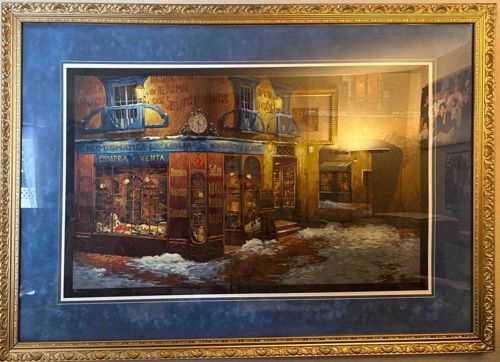
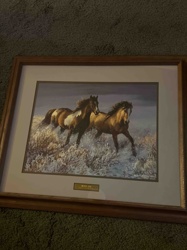
This item is a framed art print, likely a giclée or offset lithograph, depicting a vibrant street scene with a prominent corner shop, possibly by the artist Viktor Shvaiko given the provided context. The print is housed under glass within a multi-layered framing system. The outermost frame is a substantial, ornate gilded gold frame, featuring a highly decorative, possibly cast or molded, relief pattern along its inner and outer edges and across its surface, presenting a classic, somewhat baroque aesthetic. Inside this is a wide, royal blue mat with a subtly textured or mottled finish, providing a significant border around the artwork. There appears to be a smaller, possibly white or cream-colored fillet or inner mat bordering the print itself, creating a visual separation from the dark blue. The print itself is a detailed rendition of a European-style street, likely reflecting a rainy or wet evening due to the shimmering reflections and puddles on the ground. The corner building, which houses a shop, is brightly lit from within, contrasting with the darker alleyway beside it. The shop's sign is partially visible, reading "NUMISMATICA" and "COMPRA - VENTA," indicating a coin or collectibles shop. An antique-style clock is mounted above the shop's entrance. The overall color palette leans towards rich blues, warm yellows, and deep browns, creating a cozy yet mysterious atmosphere. The visible condition of the frame shows some minor wear consistent with handling, but no major damage is apparent. The glass appears clean, and the print itself seems well-preserved behind it, with no obvious fading or discoloration. The craftsmanship of the frame is robust, suggesting a professional framing job designed to protect and enhance the artwork. The style suggests a contemporary production, likely from the late 20th to early 21st century, consistent with a widely distributed art print.
AI Appraisal Report
I have examined the provided image of the framed art print, ostensibly by Viktor Shvaiko, depicting a 'Numismatica' shop. Based on my visual inspection, the item presents as a professionally framed art print, likely a giclée or offset lithograph, given the common distribution of Shvaiko's work. The framing itself is robust and aesthetically pleasing, featuring an ornate gilded frame, a wide royal blue mat, and a subtle inner fillet, all contributing to its presentation. The print itself appears to be in excellent condition behind glass, with no visible fading, creases, or discoloration. The frame shows only minor wear consistent with careful handling, not significant damage.
From a market perspective, Viktor Shvaiko's limited edition prints are quite popular and widely collected. While original paintings fetch significantly higher prices, framed prints like this typically fall within an accessible range. Demand for his romanticized street scenes remains consistent. Factors impacting value here include the print's condition, the quality of the framing, and the edition size (if it is a limited edition, which cannot be determined from the image). The 'Numismatica' theme is attractive due to its detailed narrative.
My primary limitation in this appraisal is the inability to physically inspect the print. Without in-person examination, I cannot definitively verify if it is an authentic licensed print, a giclée, an offset lithograph, or a simple poster print. I cannot confirm the presence of an artist's signature (original or plate-signed), edition number, or publisher's chop mark, which are crucial for authenticity and determining edition quality. Physical examination would also allow for a direct assessment of print quality and true color vibrancy. Provenance documentation, such as a certificate of authenticity or purchase receipts, would greatly enhance verification. Without these, the appraisal must assume it is a widely distributed, well-produced print. Scientific testing, like spectral analysis, would be overkill for a print but could confirm ink types if deeper authentication were ever required for an unusual circumstance.