These notes were written by the person who submitted this item. Appraiser.AI has not verified them, and the AI's identification and estimate may rely on them.
AI Estimated Value
Not an official valuation
$1,800 - $3,000
AI estimate as of September 26, 2025 · verify with a professional before acting
AI-Generated · Verify before acting
Everything on this page is generated by AI for informational purposes only. AI can make mistakes — the AI may misidentify items or misattribute them (artist, maker, brand, designer, origin, era). This is not an official valuation and should not be used for insurance, sale, tax, estate, legal, or lending purposes — or any decision requiring a certified appraisal. It is not an authoritative claim about any person, brand, or rights holder — do not share or rely on it as a factual statement about a third party. Always consult qualified professionals before making financial decisions.
This analysis also relies on unverified notes provided by the user, which may be incomplete or inaccurate and could affect the result.
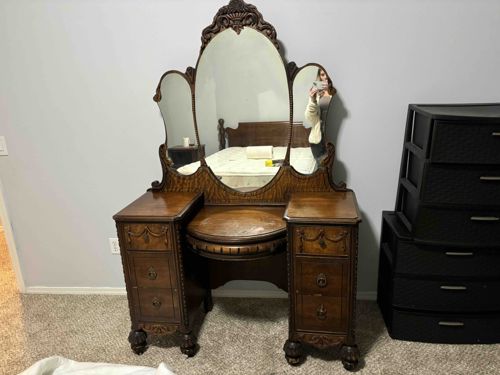
This is an antique wooden vanity dressing table, characterized by its ornate carvings and a distinctive tri-fold mirror. The piece appears to be constructed from a dark-stained hardwood, likely oak or mahogany, given its grain and color, which has developed a rich patina over time. It features a central vanity section with a circular recessed area, presumably for a matching stool (a wooden stool top is visible within this recess), flanked by two drawer pedestals. Each pedestal has three drawers, adorned with decorative metal pull handles. The top drawer of each pedestal features intricate carved garland or swag motifs, indicating a classical or early 20th-century aesthetic. The overall construction exhibits quality craftsmanship with visible joinery and detailed carving. The legs of the pedestals are carved into stylistic paw or claw feet, adding to its elaborate design. The vanity is topped with a grand tri-fold mirror assembly; the central mirror is the largest, with a highly decorative, carved crest featuring rococo or Baroque-inspired elements such as scrolls and foliate designs. The two smaller side mirrors are also carved and articulated to fold inwards, suggesting they provide different viewing angles. There are no obvious signs of major damage or repairs from the image, but typical age-related wear, such as minor scratches, dings, and surface variations consistent with an antique item, would be expected. The mirror glass appears to be in good condition, reflecting the room clearly. This style of vanity with extensive carving and a tri-fold mirror was popular in the late Victorian or Edwardian periods, placing its estimated age between the late 19th century and early 20th century.
AI Appraisal Report
Upon visual examination of the provided image, I assess this Antique Carved Vanity Dressing Table with Tri-Fold Mirror and Stool to be a genuinely antique piece, likely dating from the late Victorian to early Edwardian period (late 19th to early 20th century). The extensive and intricate carvings, particularly the rococo/Baroque-inspired crest on the central mirror and the paw/claw feet, are hallmarks of this era's furniture design, emphasizing ornate aesthetics and craftsmanship. The dark-stained hardwood, exhibiting a rich patina, appears consistent with oak or mahogany, frequently used for such quality pieces. The original hardware and the visible joinery further support its authenticity and age. The condition appears very good for its age, showing typical age-related wear such as minor surface imperfections, but no significant damage or repairs are evident from the image. The mirror glass seems intact and clear, which is a positive factor.
Market conditions for well-preserved, ornate antique furniture, particularly functional pieces like vanities with significant visual appeal, remain stable with a dedicated collector base. Comparables for such detailed, complete vanities (including the stool element) typically range from $1,500 to $3,500. This piece's tri-fold mirror configuration and the presence of the integrated stool (even if just the top is visible) enhance its desirability. The intricate carving elevates its artistic and historical value, contributing positively to demand. Rarity is moderate; while vanities from this period exist, one with this level of carving, structural integrity, and completeness with its mirror and stool is less common.
Factors significantly impacting value include its excellent condition, the artistic quality of the carvings, and its completeness. The original finish and hardware also add to its allure. However, it's crucial to note the limitations of image-based appraisal. For full authenticity verification, an in-person examination is essential to inspect the wood type, construction methods (e.g., dovetail joints, hand-planing marks), and hardware for originality. Provenance documentation, if available, would further solidify its history. Scientific testing, such as dendrochronology, could precisely date the wood, but is rarely necessary for furniture of this type unless significant doubt arises. Without physical inspection, I cannot rule out professional repairs or structural weaknesses that might not be visible in the photograph.