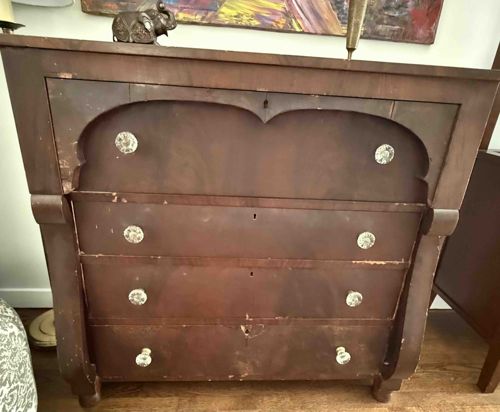
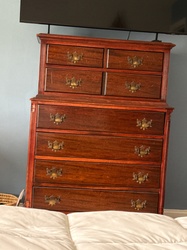
Antique wood dresser with crystal knobs, antique keyhole, heavy
These notes were written by the person who submitted this item. Appraiser.AI has not verified them, and the AI's identification and estimate may rely on them.
AI Estimated Value
Not an official valuation
$400-700
AI estimate as of August 23, 2025 · verify with a professional before acting
AI-Generated · Verify before acting
Everything on this page is generated by AI for informational purposes only. AI can make mistakes — the AI may misidentify items or misattribute them (artist, maker, brand, designer, origin, era). This is not an official valuation and should not be used for insurance, sale, tax, estate, legal, or lending purposes — or any decision requiring a certified appraisal. It is not an authoritative claim about any person, brand, or rights holder — do not share or rely on it as a factual statement about a third party. Always consult qualified professionals before making financial decisions.
This analysis also relies on unverified notes provided by the user, which may be incomplete or inaccurate and could affect the result.
This is an antique wooden dresser, likely a chest of drawers or commode, characterized by its deep reddish-brown finish. The dresser features a unique top drawer configuration, with the upper-most drawer having a distinct arch-shaped front panel and a central heart-like or stylized keyhole escutcheon. Below this, there are four additional drawers, each of varying sizes, with the uppermost of these appearing to be a single, large deep drawer, and the three below it being of more standard depth. The dresser is adorned with a total of ten crystal or glass facet-cut knobs, with two on the top arched drawer and two on each subsequent drawer below. Some of these knobs show signs of wear or possible chips. The construction appears to be heavy, typical of antique furniture. The sides of the dresser have a gently curved or 'sleigh' style, providing a distinctive silhouette. The wood exhibits significant wear, including scratches, scuffs, and areas where the finish has chipped or rubbed off, particularly around the edges, corners, and drawer fronts. There are visible 'antique keyhole' placements on several drawers, suggesting functionality or merely decorative elements where keys would once have locked the drawers. This piece likely dates to the 19th century, possibly Empire or late Federal style, given its robust form and the details of the top drawer and side panels. The craftsmanship, though showing wear, indicates solid construction and period-appropriate techniques, pointing to a quality piece of its era.
AI Appraisal Report
I have examined the provided image and the owner's description of this Antique Empire/Federal Style Wooden Dresser with Crystal Knobs. My assessment is based on visual observations and general knowledge of antique furniture. The dresser exhibits characteristics consistent with 19th-century Empire or late Federal styles, particularly its robust form, arch-shaped top drawer, and 'sleigh' sides. The crystal knobs, while possibly period replacements, align with the aesthetic of the era. The presence of 'antique keyhole' placements further suggests a period piece.
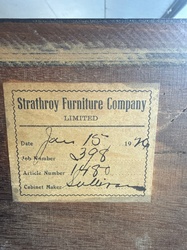
Condition-wise, the dresser shows significant wear, including scratches, scuffs, and finish loss, which is typical for a piece of this age and daily use. Some crystal knobs appear chipped, which impacts aesthetic appeal. These condition issues will necessitate restoration for optimal value, but they also attest to the item's age and history. Without an in-person examination, it's difficult to ascertain specific wood types, construction techniques (e.g., dovetailing), or hidden damages that would confirm full authenticity and structural integrity. Provenance documentation, such as family records or original purchase receipts, would also greatly aid in authentication and value assessment.
In terms of market conditions, demand for Empire/Federal style furniture remains steady among collectors who appreciate historical pieces, though it's not as robust as it once was for highly ornate Victorian or Arts & Crafts styles. Pieces in original, unrestored condition, even with wear, can be desirable to buyers who prefer authentic patinas. However, the extent of the finish wear on this piece means many buyers would factor in the cost of professional refinishing. Comparables in similar condition typically fall within a modest range, with restored examples fetching higher prices. The rarity of this specific configuration (especially the arched top drawer) could slightly enhance its appeal.
Factors significantly impacting value include the visible wear, the condition of the crystal knobs, and the general market for similar antique furniture. The lack of documented provenance is also a limitation. For a full authentication and to establish a precise value, an in-person inspection to examine joinery, wood grain, and any hidden repairs would be essential. Scientific testing could also verify wood age. Without this, my appraisal is based on visual cues, which are generally reliable but not definitive for full authentication.