These notes were written by the person who submitted this item. Appraiser.AI has not verified them, and the AI's identification and estimate may rely on them.
AI Estimated Value
Not an official valuation
$300-500
AI estimate as of December 10, 2025 · verify with a professional before acting
AI-Generated · Verify before acting
Everything on this page is generated by AI for informational purposes only. AI can make mistakes — the AI may misidentify items or misattribute them (artist, maker, brand, designer, origin, era). This is not an official valuation and should not be used for insurance, sale, tax, estate, legal, or lending purposes — or any decision requiring a certified appraisal. It is not an authoritative claim about any person, brand, or rights holder — do not share or rely on it as a factual statement about a third party. Always consult qualified professionals before making financial decisions.
This analysis also relies on unverified notes provided by the user, which may be incomplete or inaccurate and could affect the result.
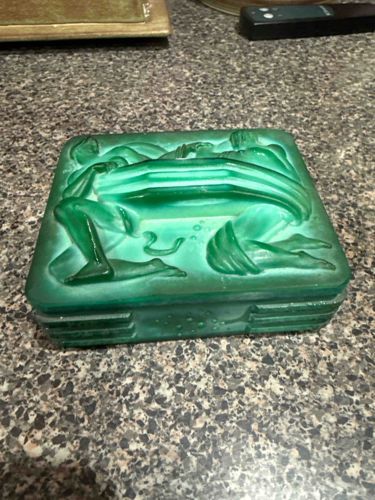
This item is a rectangular trinket box crafted from malachite glass, exhibiting a rich, opaque emerald green color characteristic of this glass type with subtle striations and color variations mimicking natural malachite stone. The lid of the box features a captivating Art Deco-style raised figural relief design depicting a stylized scene. On the left side, a semi-nude classical figure, possibly a nymph or goddess, reclines or is in motion, while on the right, another figure, possibly a mermaid, is partially visible, blending into decorative wave-like or drapery elements. A central, elongated wave or fabric element seems to flow between them. The relief carving is pronounced, creating interesting shadow play and highlighting the depth of the design. The construction appears to be molded glass, with the lid fitting snugly over the base. The sides of the base feature a stacked, stepped design, further emphasizing the geometric and streamlined aesthetics typical of the Art Deco period. The overall condition appears good, with no overt chips or cracks visible from the provided image, though minor surface wear or scratches, commensurate with age and use, may be present and are difficult to ascertain without closer inspection. The glossy finish of the glass is evident. The item likely dates from the 1920s to 1940s, a prime era for malachite glass production. There are no discernible maker's marks or signatures visible in the current view, which is common for many glass items of this period. The craftsmanship is indicative of a factory-produced piece, utilizing molds to achieve the intricate relief, yet the depth and clarity of the design suggest good quality molding techniques.
AI Appraisal Report
Based on my visual examination of the provided image, this Art Deco Malachite Glass Trinket Box with a figural scene presents as an authentic piece from the 1920s-1940s. The malachite glass exhibits the expected rich opaque emerald green color with subtle striations, characteristic of this sought-after glass type. The Art Deco-style raised figural relief on the lid, depicting classical figures in a dynamic setting, is well-defined, suggesting good quality molding. The stepped design on the base further reinforces its Art Deco origins.
The overall condition appears good from the image; I see no obvious chips or cracks. However, a physical inspection would be crucial to determine minor surface wear, scratches, or any internal flaws which can sometimes be present in molded glass of this age. Without direct handling, I cannot fully assess the fit of the lid to the base or the precise 'feel' of the glass.
In terms of market conditions, malachite glass items with figural or artistic relief designs are consistently sought after by collectors of Art Deco and specialized glass. Comparables often include pieces by manufacturers known for malachite glass, such as Josef Inwald or Desna. The lack of a discernible maker's mark, while common, means it cannot be attributed to a specific, highly collectible firm without further investigation, which would elevate its value significantly. The subject matter of this relief is appealing, contributing to its desirability.
Demand for well-preserved Art Deco decorative arts remains steady. The rarity of this specific design is moderate; while malachite glass boxes are not exceedingly rare, this particular figural scene is less common than purely geometric designs. Factors impacting value include condition, specific manufacturer (if identified), and the artistic merit of the design.
For full authenticity verification and a more precise valuation, I would require an in-person examination to assess the glass quality, molding sharpness, and minute imperfections. Provenance documentation, if available, could confirm its history and potentially identify a maker. Scientific testing, such as spectroscopy, is generally not required for this type of item unless there are serious doubts about the glass composition.