AI estimate as of October 15, 2025 · verify with a professional before acting
AI-Generated · Verify before acting
Everything on this page is generated by AI for informational purposes only. AI can make mistakes — the AI may misidentify items or misattribute them (artist, maker, brand, designer, origin, era). This is not an official valuation and should not be used for insurance, sale, tax, estate, legal, or lending purposes — or any decision requiring a certified appraisal. It is not an authoritative claim about any person, brand, or rights holder — do not share or rely on it as a factual statement about a third party. Always consult qualified professionals before making financial decisions.
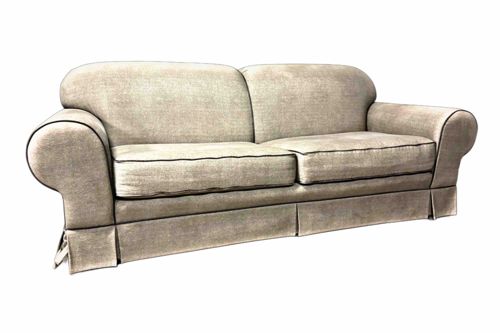
This is a traditional style two-seat upholstered sofa, likely designed for comfort and classic interior aesthetics. The sofa features a light, neutral-toned fabric, possibly a linen blend or textured velvet, that exhibits a subtle sheen, suggesting a soft pile. Its overall coloration is a muted beige or greige, which would blend seamlessly into various décor palettes. The sofa’s silhouette is characterized by rolled arms, which curve gracefully downward from the backrest, and a rounded back cushion profile. A distinctive feature is the dark piping or welt trim, possibly black or dark brown, which outlines the edges of the arms, the top and bottom edges of the back cushions, and both sides of the seat cushions. This piping provides a crisp contrast and defines the sofa's form. The two individual seat cushions are removable, indicating ease of cleaning and potential for rotation to extend longevity. The base of the sofa is concealed by a gathered or skirted bottom, consisting of multiple flat panels, which adds to its traditional appeal and hides the sofa's legs or frame. The fabric appears to be in good condition, showing no significant visible wear, tears, or stains from the provided image. The cushions display a moderate level of plumpness, suggesting adequate fill and maintained structure. Given its design elements, including the rolled arms, skirted base, and piping, this sofa likely dates from the late 20th century to early 21st century, embodying a timeless, classic style.
AI Appraisal Report
I have examined the provided image of this Traditional Two-Seat Upholstered Sofa. Based on my visual assessment, the sofa appears to be in good condition. The neutral-toned fabric shows no obvious signs of wear, tears, or significant staining, and the cushions maintain a good level of plumpness, suggesting well-maintained internal structure. The dark piping provides a crisp detail and appears intact. The design, with its rolled arms, dual removable seat cushions, and gathered skirted base, strongly indicates a traditional style, likely manufactured in the late 20th to early 21st century.
Market conditions for traditional upholstered furniture of this type are generally moderate. While classic styles consistently have a presence, this specific design is not particularly rare or iconic, placing it in a broad category of accessible home furnishings. Comparables would include similar two-seat sofas from mainstream furniture retailers, especially those featuring a neutral palette and classic details like rolled arms and a skirted base, typically ranging from new prices of $800-$1500. For the secondary market, this translates to a lower value unless it's a recognized brand or historical piece.
Factors impacting value positively include its seemingly good condition and versatile neutral color, which broadens its appeal. However, the lack of a prominent designer or manufacturer, and its common style, prevent it from commanding a high price. The value reflects typical depreciation for upholstered goods.
It is important to note that this is an appraisal based solely on visual examination of an image. I cannot definitively verify the authenticity of the material composition (e.g., fabric blend), the quality of internal construction (frame, spring system, cushion fill density), or hidden damage without an in-person examination. Physical inspection would allow me to feel the fabric, test cushion resilience, inspect the underside for manufacturer labels, and check for odors, deeper stains, or structural integrity issues that are not visible in a photograph. Provenance documentation, if available, could provide details on the manufacturer, original purchase date, and retail price, aiding in a more precise valuation.