These notes were written by the person who submitted this item. Appraiser.AI has not verified them, and the AI's identification and estimate may rely on them.
AI Estimated Value
Not an official valuation
$400-700
AI estimate as of July 10, 2025 · verify with a professional before acting
AI-Generated · Verify before acting
Everything on this page is generated by AI for informational purposes only. AI can make mistakes — the AI may misidentify items or misattribute them (artist, maker, brand, designer, origin, era). This is not an official valuation and should not be used for insurance, sale, tax, estate, legal, or lending purposes — or any decision requiring a certified appraisal. It is not an authoritative claim about any person, brand, or rights holder — do not share or rely on it as a factual statement about a third party. Always consult qualified professionals before making financial decisions.
This analysis also relies on unverified notes provided by the user, which may be incomplete or inaccurate and could affect the result.
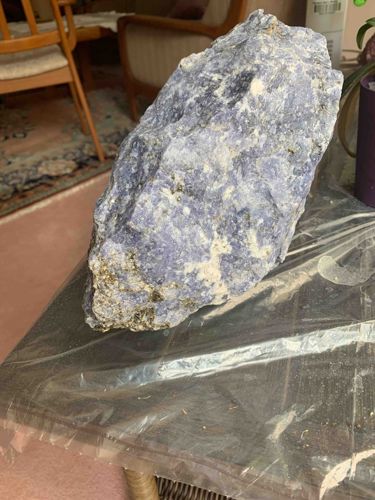
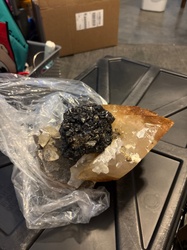
This item is a large, rough specimen of a mineral, most likely a form of massive sapphire or a sapphire-bearing rock given its distinct blue-lavender coloration and context as a 'mineral'. It exhibits an irregular, unpolished or un-tumbled form, indicative of a natural, raw state. The dominant color is a mottled blue-grey to light purple, with significant white to off-white inclusions and patches throughout its surface, suggesting the presence of other minerals or host rock. There are also visible areas of darker speckles and what appears to be metallic or pyritic inclusions, particularly concentrated in some of the recesses and along natural fracture lines, which show a yellowish-brown to brassy hue. The surface texture is notably rugged and uneven, with various natural fissures, crevices, and crystalline faces. Its size is substantial, appearing to be at least a foot in its longest dimension, resting on a table, implying a considerable weight. The light reflections suggest a somewhat dull to sub-vitreous luster on its naturally broken surfaces. There are no clear signs of human-made modifications such as cuts, polishing, or drill holes, indicating it is an untouched geological sample. No discernible maker's marks, signatures, or stamps are visible. The overall condition appears to be natural and stable, with no visible recent damage or repairs, only the inherent characteristics of a rough mineral specimen. Its estimated age is geological, given its natural formation.
AI Appraisal Report
Based on my visual examination of the provided image, this large mineral specimen appears to be a natural, un-modified piece of rock exhibiting a distinct blue-lavender coloration with significant white and darker inclusions. Its rough, unpolished state strongly suggests a natural origin. The presence of what appear to be metallic or pyritic inclusions with a yellowish-brown hue adds to its complexity. Given its purported identification as 'Massive Blue Mineral Specimen (Possible Sapphire or Corundum-bearing Rock)' by the owner, I've assessed its potential as a geological specimen rather than a cut gemstone.
Market conditions for large, rough mineral specimens, even those potentially containing sapphire or corundum, are highly niche. True sapphire or gem-quality corundum in its raw form is rarely sold in such massive, unrefined pieces unless intended for further processing. This specimen, appearing primarily as a matrix rock with mineral presence, would likely appeal to mineral collectors, geological institutions, or lapidary artists interested in experimental cutting. Comparables are challenging without definitive mineral identification, but similar large, attractive mineral aggregates with interesting colors can command moderate prices. Demand is limited to specialized collectors, but rarity for a specimen of this size with compelling coloration, even if non-gem quality, can be a factor.
Factors significantly impacting value include the definitive identification and concentration of sapphire/corundum within the matrix, the stability of the inclusions (e.g., iron staining from pyrite), and its aesthetic appeal as a natural sculpture. Without physical inspection, I cannot definitively confirm the mineral composition. Visual examination alone is insufficient for authenticating the presence or quality of corundum/sapphire. For full authentication and to ascertain gemological potential, an in-person examination by a certified gemologist or mineralogist is crucial. This would involve specific gravity tests, hardness tests, refractometer readings, and potentially X-ray diffraction or electron microprobe analysis to confirm the presence and concentration of corundum and to identify all constituent minerals. Provenance documentation regarding its discovery site would also be valuable.