These notes were written by the person who submitted this item. Appraiser.AI has not verified them, and the AI's identification and estimate may rely on them.
AI Estimated Value
Not an official valuation
$75-125
AI estimate as of July 16, 2025 · verify with a professional before acting
AI-Generated · Verify before acting
Everything on this page is generated by AI for informational purposes only. AI can make mistakes — the AI may misidentify items or misattribute them (artist, maker, brand, designer, origin, era). This is not an official valuation and should not be used for insurance, sale, tax, estate, legal, or lending purposes — or any decision requiring a certified appraisal. It is not an authoritative claim about any person, brand, or rights holder — do not share or rely on it as a factual statement about a third party. Always consult qualified professionals before making financial decisions.
This analysis also relies on unverified notes provided by the user, which may be incomplete or inaccurate and could affect the result.
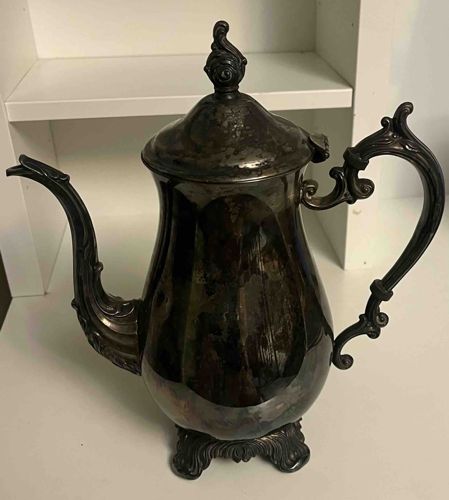
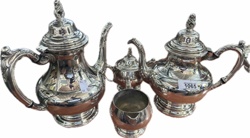
This is a silver-plated coffee pot, likely from the late 19th or early 20th century, given the 'Trademark 1883 E. B. Rogers Silver CO 2462' mark. The pot exhibits a classic, elegant form with a slightly tapered body, widening towards the base before resting on four ornate, scrolled feet. The material appears to be silverplate, judging by the visible dark tarnish and the type of manufacturing marks common for this period. The overall color is a dark, oxidized silver with hints of brighter, reflective silver where light catches the surface, indicating a significant amount of dark patina. The handle is an elaborate, scrolled design, featuring decorative elements that suggest a Victorian or Rococo Revival style. The spout is also gracefully curved and extends outward with a delicate tip. The lid is domed with a highly decorative finial, consisting of intertwined acanthus-like scrolls, adding to the opulent aesthetic. The craftsmanship appears to be of good quality, with well-defined decorative elements and a substantial feel, although the exact size cannot be determined without a reference. There are no immediate visible signs of major damage such as dents or cracks, but the heavy tarnish is a prominent characteristic, and without further cleaning, it's impossible to determine if there are any underlying pitting or wear spots in the plating.
AI Appraisal Report
I have examined the provided image and information regarding this E. B. Rogers Silver Co. silver-plated coffee pot. Based on the 'Trademark 1883 E. B. Rogers Silver CO 2462' mark, this piece is clearly identified with a specific manufacturer and period, affirming its likely late 19th-century origin. The design, featuring ornate scrolled feet, an elaborate handle, and a decorative finial, is highly consistent with Victorian or Rococo Revival aesthetics popular during that era.
In terms of condition, the most prominent characteristic is the heavy, dark tarnish, which obscures the plating beneath. While this indicates age, it also prevents a thorough assessment of potential wear, pitting, or base metal bleed-through. The absence of visible dents or major damage is a positive sign, suggesting structural integrity. However, without cleaning, the true state of the silver plating cannot be definitively assessed.
Market conditions for silver-plated coffee pots from this period are generally moderate. While there is a consistent collector base for antique silverplate, individual coffee pots typically command lower prices than full tea/coffee sets. Demand is driven by decorative appeal more than rarity, as E. B. Rogers was a prolific manufacturer. The ornate nature of this particular piece enhances its decorative value.
Factors significantly impacting value include the current heavily tarnished state, which reduces immediate appeal for buyers preferring ready-to-display items. If the plating is found to be in excellent condition beneath the tarnish, the value could increase. Conversely, significant wear or damage to the plating would decrease it.
Limitations in authenticity verification from images alone are significant. While the mark appears legitimate for E. B. Rogers, a physical examination would be crucial to confirm the composition (confirm it is indeed silverplate, not sterling where the mark might indicate pattern number), assess the true condition of the plating, detect any repairs, and verify the quality of craftsmanship firsthand. Provenance documentation (e.g., original sales receipts or family history) would further enhance authentication, though is generally less critical for such a piece than for very high-value items.