These notes were written by the person who submitted this item. Appraiser.AI has not verified them, and the AI's identification and estimate may rely on them.
AI Estimated Value
Not an official valuation
$75-125
AI estimate as of July 20, 2025 · verify with a professional before acting
AI-Generated · Verify before acting
Everything on this page is generated by AI for informational purposes only. AI can make mistakes — the AI may misidentify items or misattribute them (artist, maker, brand, designer, origin, era). This is not an official valuation and should not be used for insurance, sale, tax, estate, legal, or lending purposes — or any decision requiring a certified appraisal. It is not an authoritative claim about any person, brand, or rights holder — do not share or rely on it as a factual statement about a third party. Always consult qualified professionals before making financial decisions.
This analysis also relies on unverified notes provided by the user, which may be incomplete or inaccurate and could affect the result.
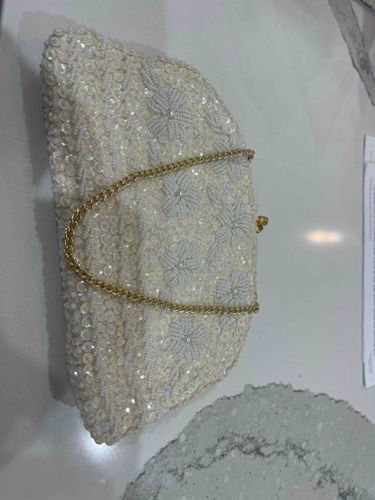
This is a vintage-style ladies' evening bag or clutch, likely dating from the mid-20th century, possibly the 1950s or 1960s, a popular period for intricately embellished accessories. The bag is off-white or ivory in color and features extensive hand-beading and sequin work. The entirety of the visible exterior surface is covered with iridescent white or clear sequins, each approximately 2-3mm in diameter, creating a shimmering effect. Interspersed among the sequins, there are clusters of white glass seed beads forming distinct floral or snowflake-like patterns, each about 1-1.5cm in diameter. These beaded motifs are arranged symmetrically across the bag's surface, lending a delicate and ornate appeal. The bag has a soft, rounded, and somewhat rectangular silhouette with a noticeable curve on the upper edge, giving it a feminine shape. A slender, gold-tone metal chain strap is attached, allowing it to be carried as a shoulder bag or tucked inside to function as a clutch. The chain appears to be a curb link style. The closure mechanism, visible on the right side of the bag, is a small, gold-tone metal clasp, possibly a kiss-lock or snap closure, which indicates a structured inner frame. There are no obvious signs of significant damage like missing beads or sequins, tears, or major staining from the provided image. The overall condition appears to be good, suggesting it has been well-preserved. The craftsmanship, particularly the detailed bead and sequin work, indicates a reasonably good quality item, characteristic of formal accessories from its presumed era. No specific maker's marks or signatures are discernible in the image.
AI Appraisal Report
I have carefully examined the provided image of this vintage beaded and sequin evening bag/clutch. Based on its design, the extensive hand-beading and sequin work, and the style of the chain and clasp, my assessment aligns with the owner's suggestion of a mid-20th century origin, likely the 1950s or 1960s. The overall condition appears to be good for its age, with no obvious signs of significant damage such as missing embellishments, tears, or major staining discernible from the image. This indicates it has been well-preserved.
From a market perspective, vintage evening bags with intricate hand-embellishment remain consistently desirable, particularly those without significant wear. While not exceedingly rare, pieces in excellent condition like this one, with dense bead and sequin work, command higher prices than more common or damaged examples. The aesthetic appeals to collectors of vintage fashion and individuals seeking unique accessories for formal events. Factors positively impacting value include the apparent good condition and the detailed craftsmanship. The lack of a designer label or provenance documentation, however, limits its highest value potential.
It is crucial to note that this authenticity assessment is based solely on visual inspection of the image. Without a physical examination, I cannot definitively confirm the age, materials (e.g., precise bead composition, metal purity), or precise construction methods. An in-person inspection would allow for tactile assessment of materials, examination of interior lining and stitching, and a more thorough search for maker's marks, all of which would contribute to a more precise authentication and valuation. Documentation of its history or a confirmed designer would also significantly impact value.