These notes were written by the person who submitted this item. Appraiser.AI has not verified them, and the AI's identification and estimate may rely on them.
AI Estimated Value
Not an official valuation
$650 - $850
AI estimate as of July 21, 2025 · verify with a professional before acting
AI-Generated · Verify before acting
Everything on this page is generated by AI for informational purposes only. AI can make mistakes — the AI may misidentify items or misattribute them (artist, maker, brand, designer, origin, era). This is not an official valuation and should not be used for insurance, sale, tax, estate, legal, or lending purposes — or any decision requiring a certified appraisal. It is not an authoritative claim about any person, brand, or rights holder — do not share or rely on it as a factual statement about a third party. Always consult qualified professionals before making financial decisions.
This analysis also relies on unverified notes provided by the user, which may be incomplete or inaccurate and could affect the result.
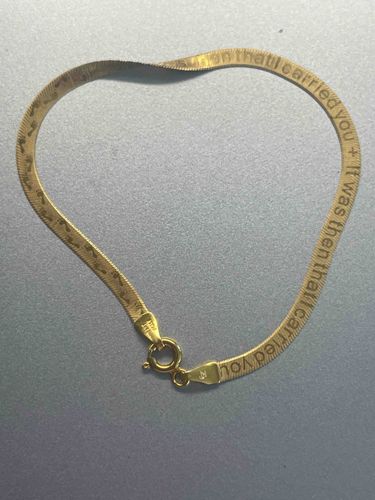
This item is a herringbone chain bracelet crafted from 14k yellow gold, as indicated by the '14k' and 'Italy' markings, suggesting its origin and purity. The bracelet exhibits a classic flat, flexible, and serpentine design characteristic of a herringbone chain, which reflects light beautifully across its smooth, polished surface along one side. The reverse side of the chain appears to have a more textured or ribbed pattern, which is typical for this type of link to ensure flexibility while maintaining structural integrity. The bracelet is secured by a spring-ring clasp, a common and reliable closure mechanism for such jewelry.
A notable and unique feature of this bracelet is the engraved inscription that runs along one side of the chain. The visible parts of the engraving read, "...on that I carried you + It was then that I carried you...". This phrasing strongly suggests that the full inscription is a quote from the popular 'Footprints in the Sand' poem, which often resonates with themes of faith, support, and perseverance. The engraving is neatly executed, appearing crisp and legible against the gold surface.
In terms of condition, the bracelet shows some signs of wear consistent with use, including minor surface scratches and a slight bend or kink in one section of the chain, which is a common characteristic of herringbone designs due to their flexible nature. The gold maintains a vibrant yellow hue, indicating good material quality. The craftsmanship appears to be of good standard, with well-formed links and a secure clasp assembly. There are visible hallmarks '14k', 'Italy', and 'JN' (possibly a maker's mark or importer's mark) near the clasp. Given the style and materials, this bracelet likely dates from the latter half of the 20th century to the early 21st century, a period when herringbone chains and inspirational jewelry were popular.
AI Appraisal Report
Upon examining the provided image and information, I assess this 14k Gold Herringbone Bracelet with a 'Footprints in the Sand' engraving. The '14k' and 'Italy' markings, along with the 'JN' hallmark, strongly support its stated purity and origin. The craftsmanship appears consistent with Italian gold jewelry, known for quality. The bracelet exhibits typical wear for its age and type, including minor surface scratches and a slight kink, which is common with flexible herringbone designs. The spring-ring clasp is intact and functional.
Market conditions for 14k gold jewelry are generally stable, influenced by gold's current spot price. Comparable herringbone bracelets of similar caratage, weight (estimated to be moderate given its flat, wide design), and condition typically retail for $500-$900. The "Footprints in the Sand" engraving adds a unique, sentimental appeal, potentially increasing demand among buyers who connect with the poem's message. While not rare, this specific combination of a quality herringbone chain with a meaningful inscription makes it more desirable than a plain chain.
Factors significantly impacting value include the gold content, the integrity of the chain (herringbone can be prone to severe kinking or breakage), and the clarity of the engraving. The minor kink observed does not significantly detract from value unless it compromises structural integrity or aesthetics more severely upon physical inspection.
Limitations in authenticity verification from images alone are crucial to note. While hallmarks are visible, their absolute authenticity cannot be guaranteed without in-person examination. A physical inspection would allow for precise weight measurement (essential for gold value), closer examination of the kink for potential compromise, microscopic analysis of hallmarks for genuineness, and confirmation of chain integrity and clasp security. Scientific testing, such as XRF analysis, would definitively confirm gold purity. Provenance documentation, if available, would further enhance authentication.