Louis XVI Style French Settee Understructure
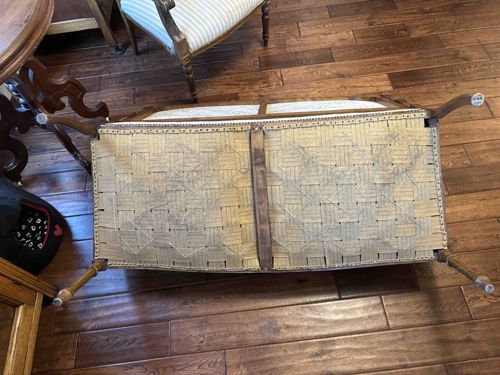
This image displays the undercarriage and structural assembly of a French Louis XVI style settee or canapé, shown upside down on a dark wood floor. The frame is constructed from solid wood, featuring four elegant cabriole legs with carved transitions. The seat support highlights traditional upholstery techniques, specifically a dense lattice of interwoven jute or burlap webbing. This webbing is secured to the frame with numerous rusted or oxidized metal upholstery tacks. A central support stretcher runs vertically through the middle of the frame to provide additional stability. The webbing is further reinforced with a series of cross-stitched twine patterns, indicating a high level of manual craftsmanship intended to support internal springs. The wood shows a warm, aged patina with visible grain. Condition issues include significant wear to the underside finish, numerous small holes from previous re-upholstery efforts, and light fraying of the textile components. The style suggests a late 19th-century or early 20th-century revival piece, exhibiting classical proportions and traditional joinery. Small plastic glides have been added to the base of the feet for modern floor protection.
AI-Generated Appraisal Disclaimer
Estimated Value
$400 - $700
Basic Information
Category
Antique Furniture
Appraised On
February 5, 2026
Estimated Value
$400 - $700
Item Description
This image displays the undercarriage and structural assembly of a French Louis XVI style settee or canapé, shown upside down on a dark wood floor. The frame is constructed from solid wood, featuring four elegant cabriole legs with carved transitions. The seat support highlights traditional upholstery techniques, specifically a dense lattice of interwoven jute or burlap webbing. This webbing is secured to the frame with numerous rusted or oxidized metal upholstery tacks. A central support stretcher runs vertically through the middle of the frame to provide additional stability. The webbing is further reinforced with a series of cross-stitched twine patterns, indicating a high level of manual craftsmanship intended to support internal springs. The wood shows a warm, aged patina with visible grain. Condition issues include significant wear to the underside finish, numerous small holes from previous re-upholstery efforts, and light fraying of the textile components. The style suggests a late 19th-century or early 20th-century revival piece, exhibiting classical proportions and traditional joinery. Small plastic glides have been added to the base of the feet for modern floor protection.
Get Your Items Appraised
Instant estimates of your treasures with AI-powered instant appraisals